

Stop Loss at a Prop Firm: Where to Place It and How to Size Around It
Where to place a stop loss on a prop firm account, how stop orders trigger, and how to size each trade so a hit stop never threatens your loss limits.
Clarity Traders does not require a stop loss on every trade, but the maximum loss limit counts your equity, including open positions, at any time. That means a trade without a stop can end an account before you close anything. The practical answer is to place every stop where your trade idea is proven wrong, then size the position so that a hit stop costs a fixed, small share of the account. This guide covers where to put the stop, how to size around it and the mistakes that turn a normal loss into a breach.
Key takeaways
- Place the stop first, where the setup is invalid, and let it decide the lot size.
- A wider stop means a smaller position, not more dollars at risk.
- The maximum loss limit counts equity, so a floating loss counts before you close the trade.
- Moving a stop further away after entry quietly raises your risk and breaks your plan.
Why the stop matters more on a prop firm account
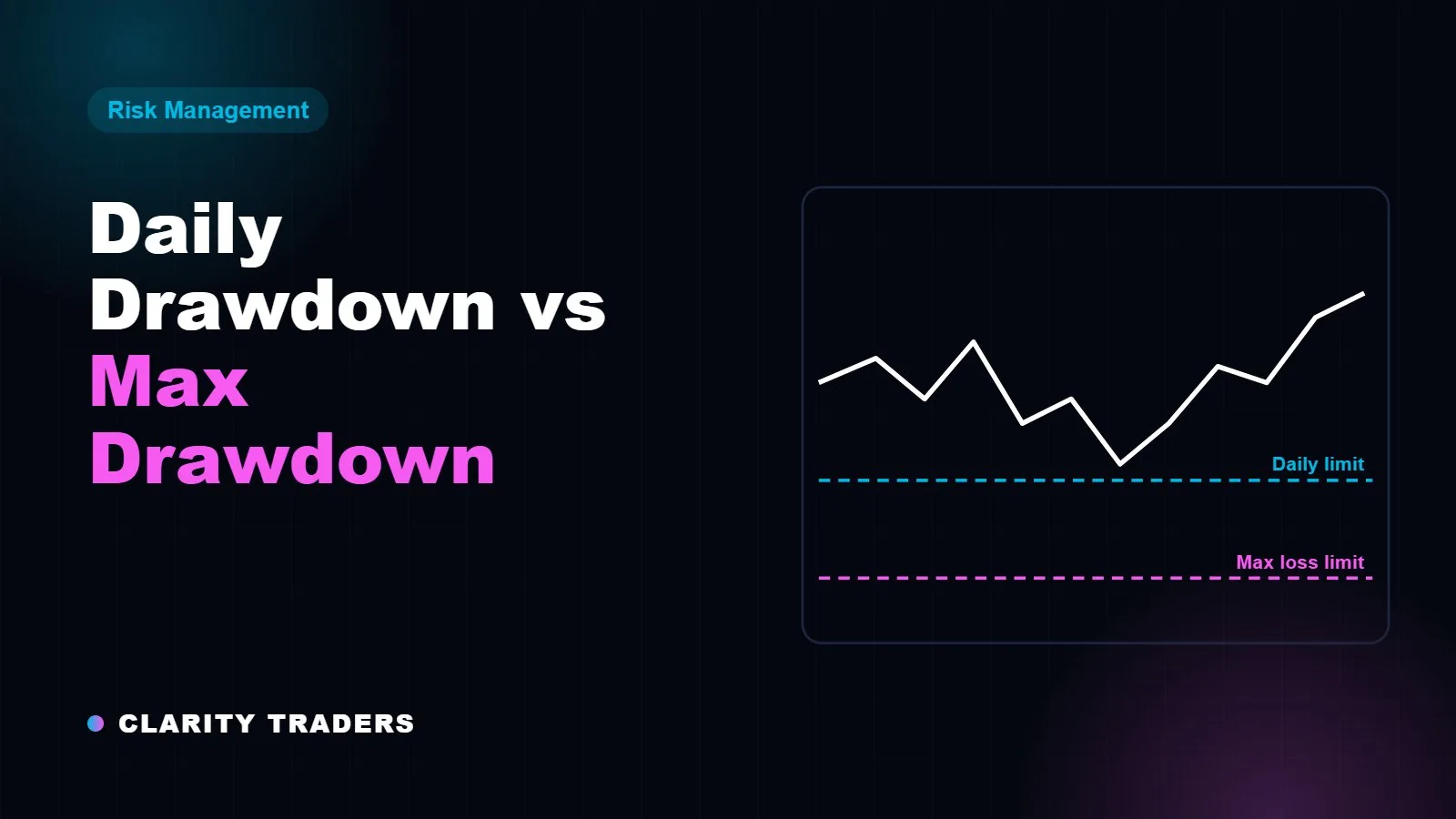
On a personal account, a bad trade costs money. On a prop firm account, it can also cost the account. At Clarity, the daily loss limit is measured from your balance at the start of each trading day, and the maximum loss limit is breached if equity falls below it at any time. Both are fixed in dollars from the account size you chose. See the trading rules for every limit and daily vs maximum drawdown for how the two interact.
A stop loss turns an open-ended risk into a known one. Without it, the only thing standing between a fast move and a breach is you, watching the screen.
How stop orders work on the platform
According to the MetaTrader 5 help pages, a Stop Loss closes the whole position when triggered, and for a long position the trigger is checked against the Bid price, while for a short position it is checked against the Ask. Stop Loss and Take Profit are held on the server, so they work even if your platform is closed. A Trailing Stop is different: MT5 runs it inside the platform, so it only moves while the platform is open.
Two practical points follow:
- Spread counts. A short position's stop is checked on the Ask, so a widening spread can trigger it even if the chart's Bid line never touches your level.
- A stop is not a promise of price. In fast markets, around news or when the market reopens after a weekend, price can move past your level and the fill can be worse than planned. Size with that in mind.
Where to place the stop
The stop belongs at the price where your reason for the trade no longer holds. Common ways traders define that point:
- Structure: beyond the swing high or low that the setup depends on. If a long is based on a higher low holding, the stop goes below that low.
- Volatility: a distance based on how far the instrument normally moves, for example a multiple of its recent average range, so ordinary noise does not stop you out.
- Invalidation level: beyond the level the setup was built around, such as a broken range edge you expect to hold on a retest.
Whatever method you use, add a small buffer for spread, and avoid placing stops exactly on obvious round numbers where many other orders sit. Write the method into your plan so every stop is placed the same way.
Size the trade from the stop
Lot size = risk in dollars ÷ (stop distance in pips × pip value per lot)
Worked example: on a $100,000 One Step evaluation, the daily loss limit is 4% ($4,000) and the maximum loss limit is 6% ($6,000). You risk 0.5% per trade, which is $500. On EUR/USD, at about $10 per pip per standard lot:
- With a 20-pip stop: 500 ÷ (20 × 10) = 2.5 lots.
- With a 40-pip stop: 500 ÷ (40 × 10) = 1.25 lots.
- Either way, it takes 8 full losses to reach the daily limit and 12 to reach the maximum.
Now take the same 2.5 lots with no stop. A 160-pip move against you is $4,000, the whole daily limit, and 240 pips reaches the $6,000 maximum. Moves of that size are uncommon on a major pair in one day, but they do happen around major news and surprises, and one is enough. Our guide to prop firm lot size covers other instruments.
[position-size-calculator]
Tight stops and costs
A tighter stop allows a bigger position for the same dollar risk, but costs grow as a share of that risk. As an illustration, if total costs are 1 pip per round trip, they equal 20% of the risk on a 5-pip stop and 5% on a 20-pip stop. Very tight stops also get hit by ordinary noise more often, which lowers your win rate. Check the risk/reward calculator with costs included before you commit to a small stop.
Common stop loss mistakes
- Moving the stop further away once price approaches it. Your planned 0.5% loss becomes 1% or more, and your average loss grows.
- Keeping the same lot size whatever the stop distance, so risk changes on every trade.
- Removing stops before news to avoid being stopped out. News trading is allowed at Clarity, but read trading the news at a prop firm first.
- Holding over the weekend without a stop. Weekend holding is allowed, but the market can reopen at a different price. See holding trades over the weekend.
- Relying on a trailing stop with the platform closed. On MT5 it only trails while the platform runs.
Trade with clear, published loss limits and no time limit to pass.
Get funded →
Frequently asked questions
Is a stop loss required at Clarity Traders?
The published rules do not require one. The maximum loss limit still applies to equity at any time, so most traders place a stop on every trade.
Should I use a mental stop instead?
A mental stop depends on you being at the screen and acting in time. A stop order on the server keeps working if your connection drops or the platform is closed.
Can I move my stop to break-even?
Yes, moving a stop closer to protect a trade is fine and lowers your risk. The problem is moving it further away.
How far should my stop be?
As far as the setup needs to be proven wrong, plus a small buffer for spread. Then size the position so that distance costs the amount you planned to risk.
All Clarity Traders accounts are simulated and use virtual funds. Trading involves significant risk. The examples are for illustration only and are not financial advice. MetaTrader 5 is a product of MetaQuotes, which is not affiliated with Clarity Traders. The Terms & Conditions take priority over any summary in this article.
All Clarity Traders accounts are simulated and use virtual funds. Rewards are based on performance in that simulation. This article is for education only and is not financial advice. Trading involves substantial risk.