Understanding Daily Drawdown vs. Maximum Drawdown in Prop Trading
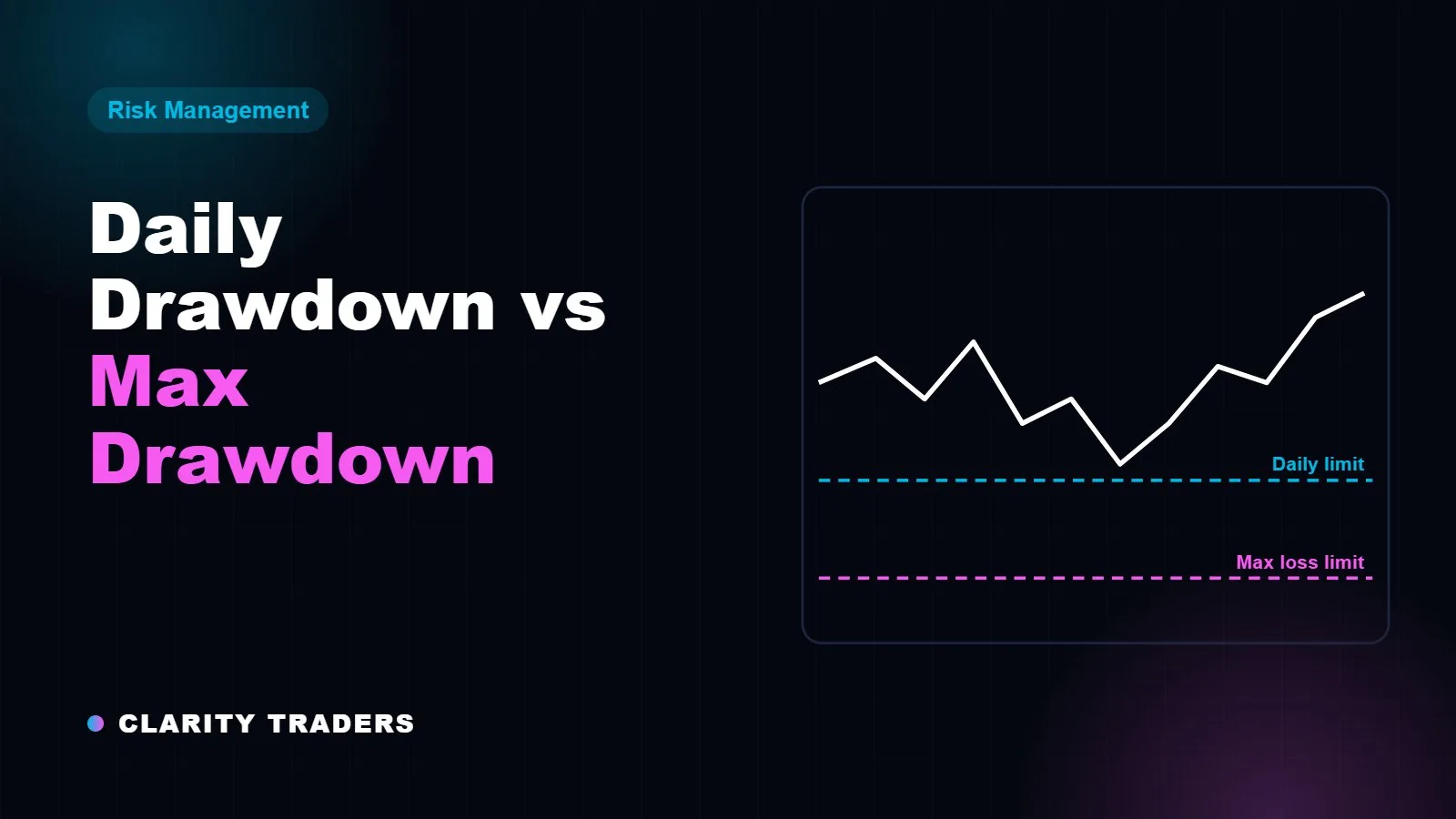
Daily drawdown limits how much you can lose in one day; maximum drawdown limits your total loss. Worked examples show how both rules work and how to stay well inside them.
Key takeaways
- The daily limit caps how much you can lose in one day; the maximum limit caps your total loss.
- The maximum limit decides how many bad days you can afford, so plan your risk around it.
- Open trades count: a floating loss can breach a limit before you close the position.
- Check your dashboard for exactly how and when each limit is measured on your account.
Drawdown rules are the reason most prop firm accounts end. Every firm uses two of them: a daily drawdown limit and a maximum (overall) drawdown limit. They sound similar, but they protect against different things, and you can breach one while being nowhere near the other.
This guide explains both rules in plain language, walks through worked examples, and shows how to build a buffer so neither one ends your account.
What is drawdown?
Drawdown is the fall in your account value from a reference point. In prop trading, the reference point is set by the firm's rules: the start of the trading day for the daily limit, and usually your starting balance (or a high-water mark) for the maximum limit.
Daily drawdown: your limit for a single day
The daily drawdown limit caps how much you can lose within one trading day. Once your account falls that far below the day's reference level, the account is breached. It resets each trading day.
At Clarity Traders the daily loss limits are:
Worked example
You trade a $50,000 Two Step account. The 5% daily limit is $2,500. You start the day at $51,000. If your account falls to $48,500 during that day, you have lost $2,500 and breached the daily limit, even though you are only $1,500 below your starting balance.
Always check on your dashboard exactly how the daily limit is measured, including whether open (floating) losses count and what time the trading day resets.
Maximum drawdown: your limit for the whole account
The maximum drawdown limit caps your total loss across the life of the account. If your account ever falls below that level, it is breached, no matter how the individual days went.
At Clarity Traders the maximum loss limits are:
- Instant: 5%
- One Step: 6% during the evaluation, 10% once funded
- Two Step: 8% during both phases, 10% once funded
Worked example
On a $100,000 One Step evaluation, the 6% maximum limit is $6,000, so your floor is $94,000. Suppose you lose 2% on Monday, 2% on Tuesday and 2.1% on Wednesday. No single day came close to the 4% daily limit, but your account is now below $94,000 and the maximum limit is breached.
This is the trap many traders fall into: a slow bleed of "acceptable" losing days that adds up.
Daily vs. maximum drawdown at a glance
- What it protects against: daily = one terrible day · maximum = a long losing run
- Resets: daily = every trading day · maximum = never
- Typical size: daily is smaller · maximum is larger
- How you usually breach it: daily = revenge trading or one oversized position · maximum = several bad days in a row
Static vs. trailing maximum drawdown
Firms calculate the maximum limit in one of two ways:
- Static: the floor is fixed relative to your starting balance. Profits move you further away from it.
- Trailing: the floor moves up as your account makes new highs, so profits do not create extra room in the same way.
Static limits are generally easier to live with. Always confirm which method your account uses in its terms, because the same percentage can behave very differently.
Want the most drawdown room in an evaluation? The Two Step allows an 8% max loss in both phases.
See Two Step rules →
How to stay inside both limits
Use a personal daily stop
Set your own daily stop at around half the firm's limit. On a 5% daily limit, stop trading for the day at 2% to 2.5%. You will rarely, if ever, see the real limit.
Size positions from the maximum limit
Decide how many consecutive losses you want to survive, then divide. If your maximum limit is 8% and you want to survive 16 losses in a row, risk 0.5% per trade.
Cap your total open risk
Three trades risking 1% each in correlated pairs (such as EUR/USD, GBP/USD and AUD/USD) behave like one 3% trade. Add up open risk across positions, not just per trade.
Build a cushion before pressing
Once you are up a few percent, your distance from the maximum limit grows (on a static limit). Many traders keep risk small until they have that cushion. Our 10 risk management rules cover this in more detail.
Respect the weekend and news gaps
Clarity allows weekend holding and news trading, but price can gap past your stop. If a gap could push you through a limit, reduce size or close before the event.
A full week, worked through
Here is one week on a $100,000 Two Step evaluation (5% daily limit, 8% maximum limit, so the floor is $92,000), assuming a static maximum limit for illustration.
- Monday: start $100,000, end $101,200 (+1.2%). Both limits comfortable.
- Tuesday: start $101,200. The daily limit of 5% is measured from this day's reference level, so the account must stay above about $96,140 today. You end at $99,900 (−1.3%).
- Wednesday: a rough day. You fall to $97,400 intraday (−2.5% on the day) and stop trading at your personal daily stop. End $97,400.
- Thursday: you are now $5,400 above the $92,000 floor. You cut risk in half and end at $98,100.
- Friday: a good day, ending $100,300.
The lesson: Wednesday's 2.5% loss was well inside the 5% daily limit, but it used more than a quarter of the total 8% room. Your maximum limit, not your daily limit, determines how many bad days you can afford.
How each Clarity account handles drawdown
Instant
A 3% daily and 5% maximum loss limit, with no profit target. The daily limit is described as trailing: it adjusts as your account's equity reaches new highs. With only 5% of total room, small risk per trade (around 0.25% to 0.5%) is essential.
One Step
A 4% daily and 6% maximum loss limit during the evaluation. Once funded, the daily limit stays at 4% and the maximum widens to 10%. The evaluation is where drawdown is tightest relative to the 10% target.
Two Step
A 5% daily and 8% maximum loss limit in both phases, then 5% daily and 10% maximum once funded. This is the most room of any Clarity evaluation.
See every limit side by side on the Compare Accounts page, and check your dashboard and account terms for exactly how each limit is calculated.
Equity vs. balance: why open trades matter
Your balance only changes when you close a trade. Your equity includes open profits and losses. Many firms measure drawdown against equity, which means a losing open position can breach a limit even if you never close it.
Picture a $50,000 One Step account with a $2,000 daily limit. You are up $600 on closed trades today, then open a position that moves $2,700 against you. Your equity is now $2,100 below the day's starting level, so the daily limit is breached while the trade is still open. Always size positions so that your stop-loss, not hope, decides your maximum loss.
Drawdown and position sizing: a quick reference
To keep any single trade from threatening your limits, cap your risk per trade at a small fraction of each limit:
- Per trade: no more than one tenth of your daily limit is a sensible ceiling. On a 5% daily limit, that is 0.5%.
- All open trades combined: no more than half of your daily limit.
- Personal daily stop: around half of the firm's daily limit.
- Losing streak buffer: enough room under the maximum limit to survive at least 12 to 16 full losses.
Five drawdown myths
- "I can't breach the daily limit if I close at a small loss." Intraday swings in open trades can breach it before you close.
- "The maximum limit resets each month." At most firms it never resets. Check your terms.
- "Profits always give me more room." Only with a static limit. Trailing limits move up with you.
- "A wide stop is safer." Only if position size shrinks to match. Risk is size times distance.
- "I'll make it back tomorrow." The maximum limit punishes exactly this thinking. Reduce size after losses instead.
Recovering when you are close to a limit
If you are within 1% to 2% of your maximum loss level, the account is not lost, but the plan has to change.
- Cut risk to a quarter of normal. At 0.125% to 0.25% per trade, a few losses will not end the account.
- Trade one setup only. Use your highest-quality pattern in your best session.
- Set a recovery milestone. For example, return to normal risk only once you are 2% above the maximum loss level.
- Close the platform after any loss during this period. Fewer trades means fewer chances to compound a mistake.
Most breached accounts are lost in the days after a drawdown, not during it. The traders who recover are the ones who slow down.
Frequently asked questions
Which is more important, daily or maximum drawdown?
Both can end your account. In practice, the daily limit is breached by emotional decisions on a single day, while the maximum limit is breached by poor position sizing over time. Plan for both.
Does the daily drawdown include open trades?
It depends on the firm. Many count floating losses. Check your account terms and dashboard so you know exactly when a breach would happen.
Does the maximum drawdown reset after a payout?
Rules vary between firms. Read your account's terms or ask support before relying on any reset.
What time does the daily drawdown reset?
Each firm sets its own reset time, often aligned with the server's end of trading day. Check your dashboard for the exact time and plan your last trades of the day around it.
Is drawdown measured on equity or balance?
Many firms use equity, which includes open trades, so an open loss can trigger a breach. Confirm the method in your account terms before you trade.
Which Clarity account has the most drawdown room?
During an evaluation, the Two Step: 5% daily and 8% maximum. Once funded, One Step and Two Step accounts both allow a 10% maximum loss.
All Clarity Traders accounts are simulated and use virtual funds. Rewards are based on performance in that simulation. This article is for education only and is not financial advice. Trading involves substantial risk.