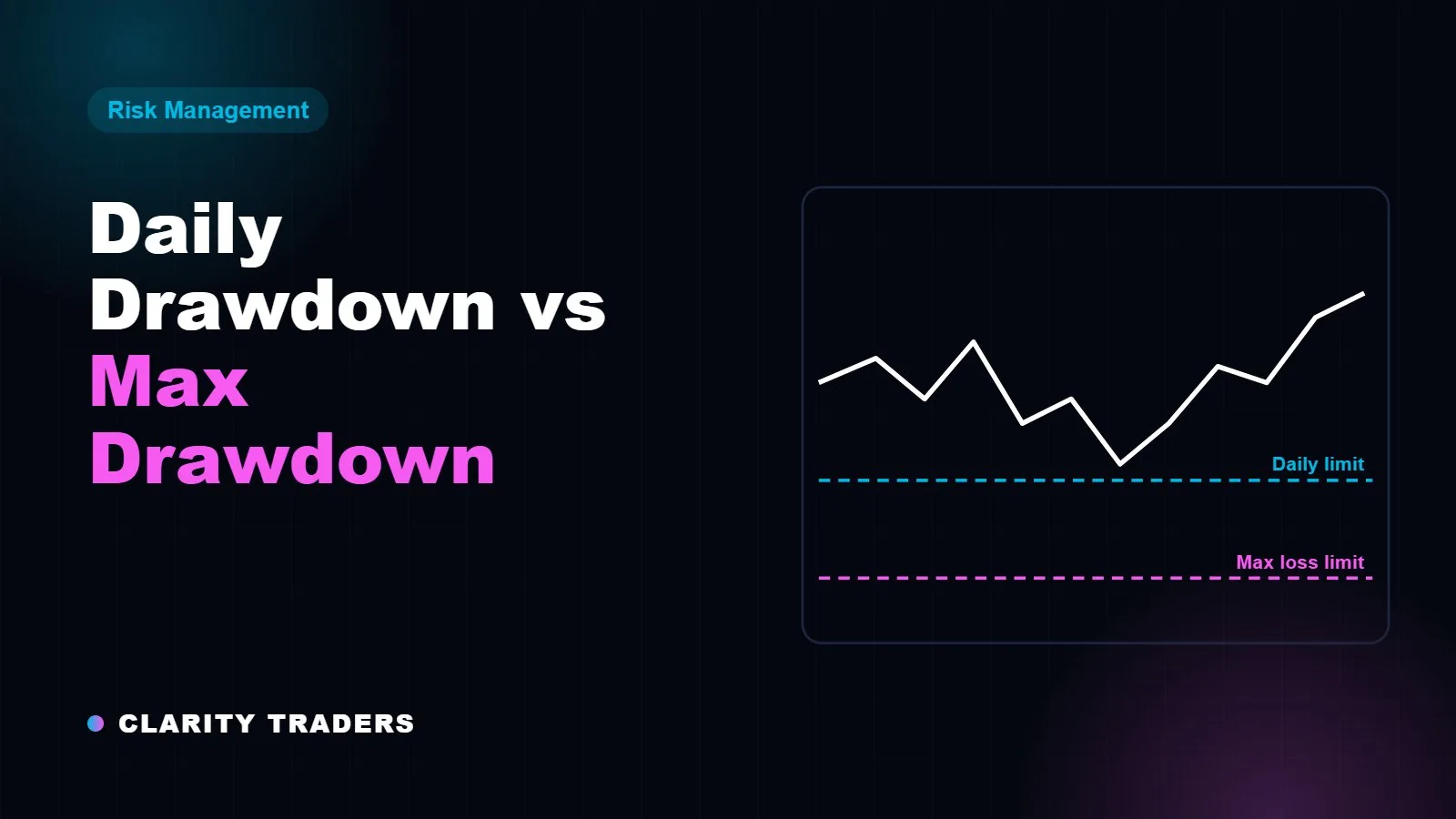


How to Recover From a Drawdown in a Prop Firm Challenge
Down on a prop firm challenge? Why a drawdown adds to your target and shrinks your room, how to resize risk and a five-step plan to recover without a breach.
To recover from a drawdown in a prop firm challenge, cut your risk per trade, keep trading the strategy that has evidence behind it, and treat the target as a long-term goal rather than something to win back this week. The maths is simple but unforgiving: every dollar you are down is a dollar added to your target and a dollar taken from your room before the maximum loss limit. This guide shows the numbers, a step-by-step recovery plan and the mistakes that turn a drawdown into a breach.
Key takeaways
- On a prop firm account, the target is fixed in dollars from your starting size, so a drawdown adds directly to what you still need to make.
- At the same time, it shrinks your room before the maximum loss limit, so the same risk per trade becomes more dangerous.
- The fix is smaller size, not bigger trades. Halving risk doubles the number of losses you can absorb.
- At Clarity Traders there is no time limit to pass, so a slower recovery costs you nothing but time.
Why a drawdown feels worse on a funded account
On your own money, a loss has to be won back as a percentage of a smaller balance: a 10% loss needs about an 11.1% gain to recover, and a 20% loss needs 25%. On a prop firm account, targets and loss limits are both set as a percentage of the account size you bought, so the dollar figures do not move. What changes is the gap on each side of your balance.
Worked example: on a $100,000 Two Step evaluation, Phase 1 asks for 8% ($8,000) and the maximum loss limit is 8% ($8,000). If you are down 4%, your balance is $96,000:
- You now need $12,000 to reach the $108,000 target.
- You have only $4,000 left before the $92,000 floor.
You need three times as much as you can afford to lose. That imbalance is why traders who keep their normal size during a drawdown so often breach the account.
Step 1: stop and find the cause
Before your next trade, look at the trades that made the drawdown. Was it a normal losing streak from a strategy with a real edge, or something else: oversized positions, trades outside your plan, revenge trades after a loss? Our trading journal template has the columns to check this quickly.
- Normal losing streak: the strategy is fine. Reduce size and keep going.
- Rule breaks or oversizing: fix the behaviour first. A smaller size will not help if you keep breaking your own plan.
- No clear edge: stop trading the account and test the strategy elsewhere before risking more of the room you have left.
Step 2: resize from the room you have left
Your risk per trade should come from the distance to the loss limit, not from the original account size. In the example above, $4,000 of room remains:
- At 1% risk ($1,000 per trade), four full losses end the account.
- At 0.5% ($500), it takes eight.
- At 0.25% ($250), it takes sixteen.
A losing streak of four to six trades is common even for a good strategy, so sizing that cannot survive it is a bet, not a plan. Use the drawdown calculator to see your limits in dollars, and our guide to prop firm lot size to turn the new risk into a position size.
[drawdown-calculator]
Step 3: accept a longer road back
Smaller size means more trades to reach the target. Say your strategy wins 45% of trades at 1:2, which works out to about +0.35R per trade on average. At 0.5% risk ($500), the $12,000 gap is 24R, or roughly 69 trades on average. At +0.20R per trade it would be about 120. These are averages for illustration, not forecasts, and real results vary.
That can feel slow, but there is no time limit and no minimum number of trading days to pass a Clarity evaluation. The only activity rule is to place at least one trade every 60 days. See the trading rules.
Step 4: protect each day
The daily loss limit is measured from your balance at the start of each trading day. In a drawdown, the maximum loss floor may sit closer than the daily limit, so whichever you would reach first is the one that matters. Set a personal daily stop well inside both, for example two full losses at your new size, and end the session when you reach it.
Step 5: scale back up slowly
Only raise size again once the account has recovered a meaningful part of the drawdown, for example half of it, and only one step at a time. Going straight back to full size after one good day puts you right back where you started if the next streak goes against you.
Common recovery mistakes
- Doubling size to win it back. It cuts the number of losses you can take in half, exactly when you have the least room.
- Switching to a new strategy. A strategy with no track record is a guess. Keep the one with evidence, or stop and test.
- Trading more often. Forcing extra setups adds lower-quality trades and more chances to lose.
- Removing stops. The maximum loss limit counts equity, so an open loss can breach the account before you close anything.
If the account does breach, read what happens if you fail a prop firm challenge and use the review to plan the next attempt.
Trade an evaluation with no time limit, so a drawdown never forces a rush.
Get funded →
Frequently asked questions
Can you pass a prop firm challenge after a drawdown?
Yes. A drawdown only ends the account if you reach a loss limit. Many traders recover by cutting risk and trading the same strategy patiently.
How much should I risk per trade during a drawdown?
Size from the room you have left. Many traders aim to survive at least eight to ten full losses before the maximum loss limit, which often means 0.25% to 0.5% of the account per trade.
Does a losing day reset the daily loss limit?
The daily limit is measured from your balance at the start of each trading day and resets when a new day begins. The maximum loss limit does not reset.
Should I wait before trading again after a big loss?
A short break is often sensible. Use it to review your journal and set your new size, then return with a written plan.
All Clarity Traders accounts are simulated and use virtual funds. Trading involves significant risk. The examples are for illustration only and are not a forecast or financial advice. The Terms & Conditions take priority over any summary in this article.
All Clarity Traders accounts are simulated and use virtual funds. Rewards are based on performance in that simulation. This article is for education only and is not financial advice. Trading involves substantial risk.