What Happens If You Fail a Prop Firm Challenge? (And What to Do Next)
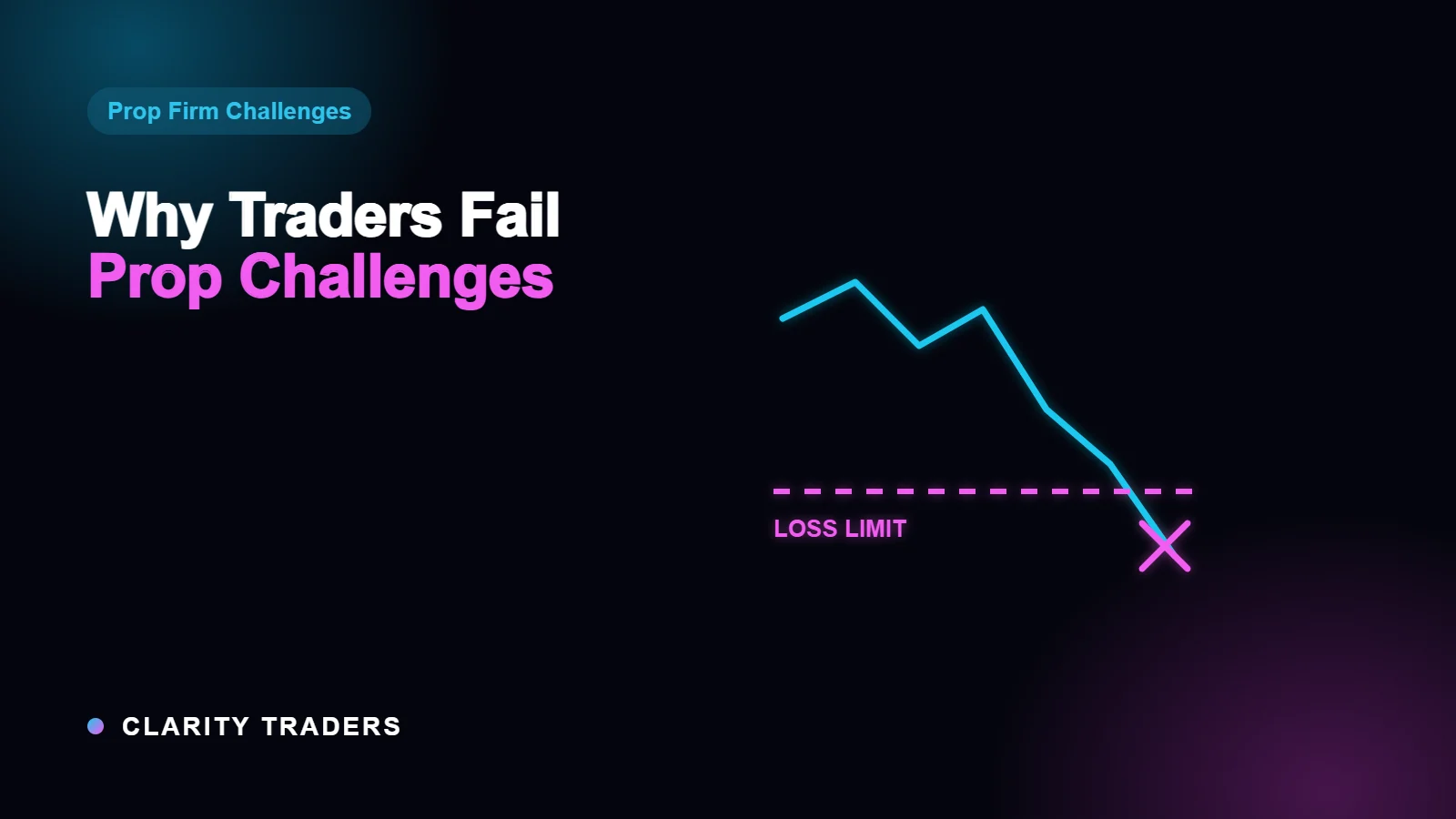
Failing a challenge usually means a breached loss limit or a rule break. Here is what happens to your account and fee, the options firms offer, and a step-by-step plan for your next attempt.

Key takeaways
- You fail a challenge by breaking a rule, usually a daily or maximum loss limit, not by running out of time at firms with no time limit.
- A failed account is closed, and the challenge fee is usually not refunded.
- A refund-guarantee add-on typically refunds the fee only after your first payout, not after a failed challenge.
- Before you buy again, find the cause in your journal and change one thing.
Most traders fail at least one challenge. It hurts, but it is also the most useful data you will get, if you use it. Here is what actually happens when you fail and how to make the next attempt different.
How you fail a challenge
- Daily loss limit: your equity falls below the day's limit, including open trades.
- Maximum loss limit: your account falls below its overall floor.
- Prohibited trading: strategies the firm bans, such as high-frequency trading, latency arbitrage, hedging across accounts or holding trades for under a minimum time.
- Time limits and minimum days: at some firms, not reaching the target in time. Clarity Traders has no time limit and no minimum trading days, so this cannot fail a Clarity account.
See every Clarity rule, in dollars, on our trading rules page.
What happens to the account and the fee
- The account closes. A hard breach ends the challenge immediately; trading on it stops.
- The fee is usually not refunded. The evaluation fee pays for the attempt, pass or fail.
- Refund add-ons apply after success. At Clarity, the optional Refund Guarantee refunds your fee with your first payout, so it helps once you pass, not after a failed challenge.
- Your history stays useful. Export or note your trades before the account is closed so you can review them.
Your options after a failed challenge
- Buy the same challenge again once you know what went wrong.
- Choose an account that suits your style. If you breached the daily limit, an account with more daily room (Clarity's Two Step has 5%) may suit you better than a tighter one.
- Drop to a smaller account size to cut the cost of each attempt while you rebuild.
- Take a break and practise. Trade a demo with the same rules for two weeks before paying again.
Pick the account whose limits fit how you trade.
Compare Clarity accounts →
A five-step reset plan
- Find the breach day. What happened, and was it one trade or several?
- Check your risk per trade. Was each loss small enough for the daily limit? Use our lot size guide.
- Count rule breaks. Trades outside your plan, revenge trades after a loss, or oversized trades near news.
- Change one thing, for example halve your risk or stop trading after two losses in a day.
- Set a personal daily stop at about half the firm's limit, so one bad day can never end the account.
[position-size-calculator]
Mistakes to avoid on the next attempt
- Buying again the same day while frustrated.
- Raising risk to make back the lost fee quickly.
- Switching strategy without testing it first.
- Trading every session. Fewer, better trades are easier to keep inside the limits.
For a full plan, read how to pass a prop firm challenge on your first attempt.
Frequently asked questions
Can I appeal a failed challenge?
If you believe a breach was caused by a platform error, contact support quickly with the trade details. Breaches caused by price moves or spreads are normally final.
Do floating losses count?
At most firms, yes. Loss limits are usually measured on equity, which includes open trades.
Is it normal to fail?
Yes. Many traders fail before they pass. What matters is whether each attempt teaches you something specific.
All Clarity Traders accounts are simulated and use virtual capital. Trading involves substantial risk.
All Clarity Traders accounts are simulated and use virtual funds. Rewards are based on performance in that simulation. This article is for education only and is not financial advice. Trading involves substantial risk.