

Balance vs Equity at a Prop Firm: Which One Your Loss Limits Use
Balance counts closed trades, equity includes open ones. How each works, which one Clarity Traders' loss limits use and how an open loss can end an account.
At a prop firm, your balance is the money in the account from closed trades only, while your equity is that balance plus or minus the profit or loss on trades that are still open. The difference matters because loss limits can be checked against either one. At Clarity Traders, the daily loss limit is measured from your balance at the start of each trading day, and the maximum loss limit is breached if your equity falls below it at any time. That means a trade you have not closed yet can still end the account. This guide explains both numbers, shows how they move during a trade and how to watch the right one.
Key takeaways
- Balance only changes when a trade closes. Equity moves with every tick while trades are open.
- At Clarity, the daily loss limit starts from your balance at the start of each trading day, and the maximum loss limit is checked on equity at any time.
- A floating loss counts against the maximum loss limit before you close the trade.
- Plan risk from your equity, not from a balance that does not yet include open trades.
Balance and equity, in plain terms
The MetaTrader 5 help pages define balance as the money on the account without the results of open positions. Equity is the balance adjusted for floating profit or loss, plus or minus a few platform items such as credit, commission and blocked profit where they apply. In practice:
- No open trades: balance and equity are the same.
- A winning open trade: equity is above balance.
- A losing open trade: equity is below balance.
On MT5 you see both on the Trade tab of the Toolbox. Our guide to using MT5 on a prop firm account shows where to find them.
Which number the loss limits use at Clarity
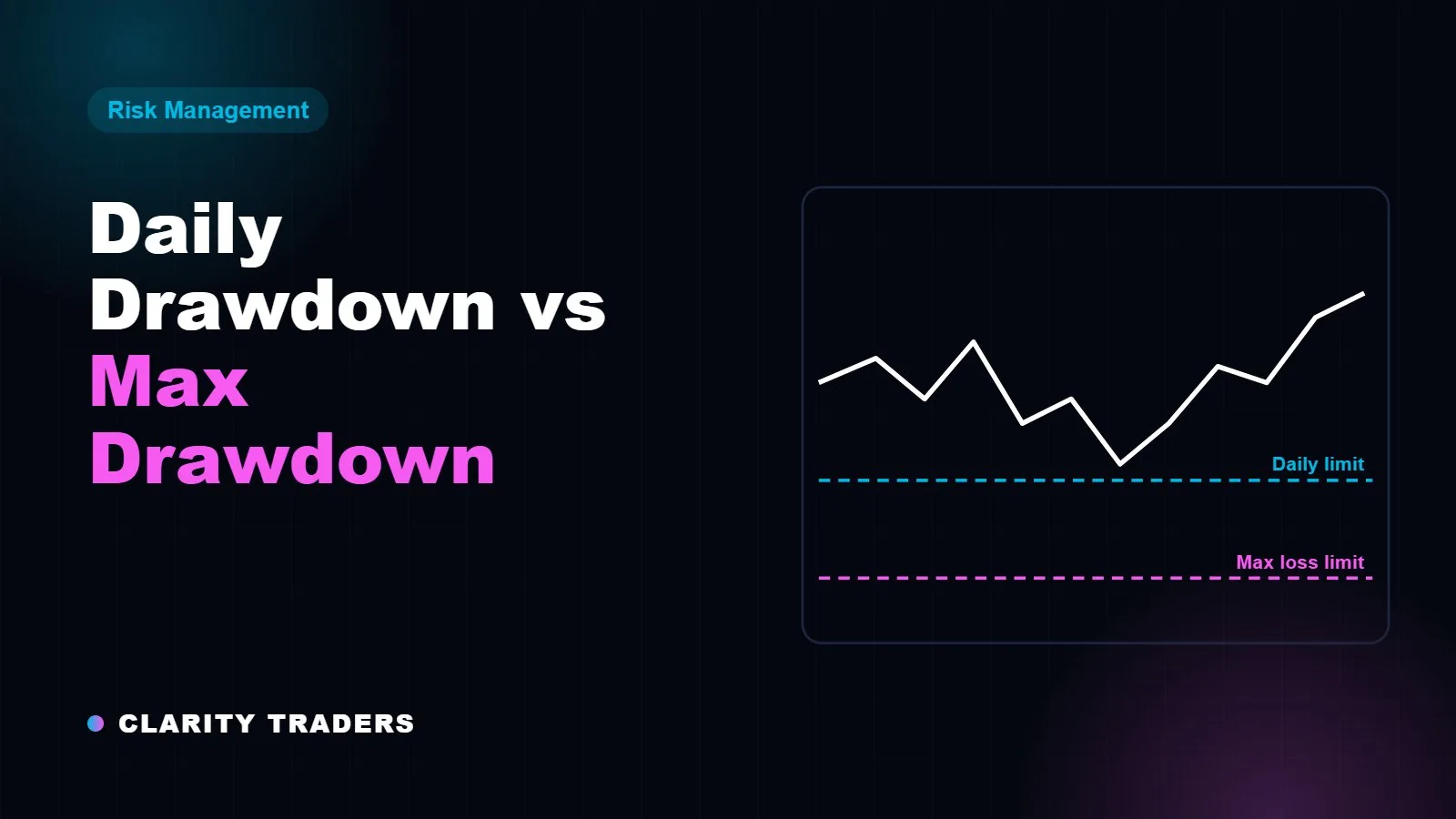
- Daily loss limit: according to the trading rules, it is measured from your balance at the start of each trading day and resets when a new day begins. The limit is 3% on Instant, 4% on One Step and 5% on Two Step.
- Maximum loss limit: the FAQ says that if your equity falls below it at any time, the account is breached and closed. It is 5% on Instant, 6% during a One Step evaluation, 8% during a Two Step evaluation and 10% once One Step or Two Step is funded.
Because the maximum loss limit is checked on equity, the safe habit is to treat every open loss as if it had already been taken, against both limits. Your dashboard shows where each floor sits for your account. For how the two limits interact, read daily vs maximum drawdown.
Worked example: an open loss that ends the account
You trade a $100,000 One Step evaluation. The 6% maximum loss limit puts the floor at $94,000. After a few losing days your balance is $97,500, so it looks like you still have $3,500 of room.
- You hold 2 lots of EUR/USD with no stop, at about $10 per pip per lot.
- Price moves 150 pips against you. The floating loss is $3,000, so equity is $94,500.
- Your balance still shows $97,500, but your real room is now $500.
- Another 50 pips against you is $1,000 more. Equity drops to $93,500, below the $94,000 floor, and the account is breached without a single trade being closed.
If the day started at that $97,500 balance, the 4% daily limit ($4,000) puts the daily floor at $93,500, so here the maximum loss floor is the one you would reach first. Whichever floor is closer is the one that matters.
[drawdown-calculator]
Floating profit is not room yet
The same logic works in reverse. If a trade is up $1,500, your equity rises, but your balance does not change until you close it. If the trade then turns into a loss, the profit you were counting on is gone and nothing was banked. Two habits help:
- Size from the stop, not from how well a trade is going. See prop firm lot size.
- Protect large open winners by moving the stop closer or taking partial profit, rather than adding size against the extra equity.
Equity, margin and free margin are different things
MT5 calculates free margin as equity minus margin, the amount set aside to hold open positions. Free margin tells you how much more you can open. It does not tell you how much you can lose. You can have plenty of free margin and still be a few hundred dollars from the maximum loss floor. Margin and risk are separate numbers.
How to track the right number while you trade
- Write down both floors before the session: the daily floor from today's starting balance, and the maximum loss floor.
- Watch equity, not balance, whenever a trade is open.
- Add up open risk: the loss on every open trade if all stops are hit at once. Equity minus that total should stay well above both floors.
- Use a stop on every trade, so an open loss has a known maximum. See where to place a stop loss.
- Close or cut size before big events if a gap could push equity through a floor.
Trade with published loss limits and no time limit to pass.
Get funded →
Frequently asked questions
Is my balance or my equity used for the maximum loss limit?
At Clarity, equity. The FAQ says the account is breached if equity falls below the maximum loss limit at any time, so open losses count.
Where does the daily loss limit start each day?
From your balance at the start of each trading day. It resets when a new day begins.
Why does my balance look fine when I am close to a breach?
Balance ignores open trades. If you have a large floating loss, equity can be far below balance. Always check equity when positions are open.
Do weekend gaps affect equity?
Yes. Holding trades over the weekend is allowed, but if the market reopens at a different price, equity moves straight to the new level. Size weekend positions with that in mind.
All Clarity Traders accounts are simulated and use virtual funds. Trading involves significant risk. The examples are for illustration only and are not financial advice. MetaTrader 5 is a product of MetaQuotes, which is not affiliated with Clarity Traders. The Terms & Conditions take priority over any summary in this article.
All Clarity Traders accounts are simulated and use virtual funds. Rewards are based on performance in that simulation. This article is for education only and is not financial advice. Trading involves substantial risk.