How to Pass a Prop Firm Challenge on Your First Attempt
Most failed challenges come down to risk, not strategy. This step-by-step plan shows how to size positions, protect your drawdown and pass on your first attempt.

Key takeaways
- Most challenges are failed on risk, not on strategy. Size every trade from your maximum loss limit.
- Risking 0.25% to 0.5% per trade lets you survive the losing streaks every strategy has.
- Set a personal daily stop at about half of the firm’s daily limit.
- Clarity evaluations have no time limit and no minimum trading days, so there is no reason to rush.
Most traders who fail a prop firm challenge do not fail because their strategy is bad. They fail because they risk too much, chase the profit target, or break a rule they did not fully understand. The good news is that all three are fixable before you place your first trade.
This guide gives you a practical, numbers-first plan for passing an evaluation on your first attempt, whether you choose a one-step or two-step challenge.
1. Know the rules better than your strategy
Before you open a chart, write down every rule that can end your attempt. At Clarity Traders, for example:
- One Step: 10% profit target, 4% daily loss limit, 6% maximum loss limit.
- Two Step: 8% target in Phase 1 and 5% in Phase 2, 5% daily and 8% maximum loss limit.
- No minimum trading days and no time limit on either.
- Trades must stay open at least 60 seconds; high-frequency and latency strategies are not allowed.
- Expert Advisors need the EA's Allowed add-on.
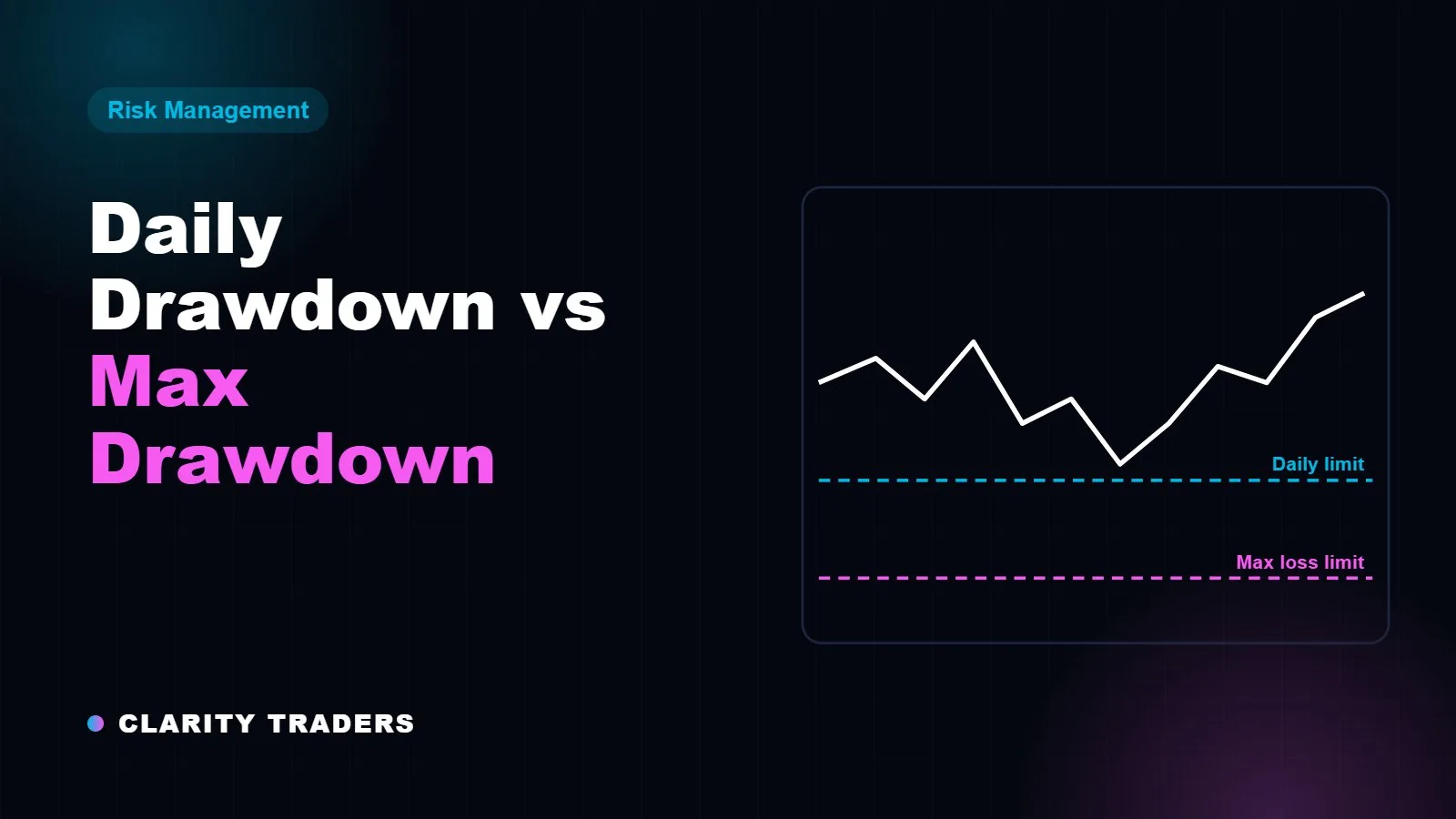
Also confirm how the daily loss limit is measured on your dashboard (for example, whether open losses count). If you are unsure how daily and maximum limits interact, read Daily Drawdown vs. Maximum Drawdown first.
2. Size your risk from the drawdown, not the target
The single most important decision is how much you risk per trade. Work backwards from your maximum loss limit.
Say you take a $100,000 One Step account. Your max loss limit is 6%, or $6,000. If you risk 1% ($1,000) per trade, six losing trades in a row end your attempt. Losing streaks of six or more are completely normal for most strategies.
At 0.5% risk ($500) you can absorb twelve straight losses. At 0.25% you can absorb twenty-four. A practical starting point for most traders is 0.25% to 0.5% per trade, which keeps you in the game long enough for your edge to show.
Quick formula
Position size = (account size × risk %) ÷ stop-loss distance. Calculate it before every trade, never after.
3. Set a personal daily stop below the firm's
If the daily loss limit is 4%, do not let yourself get anywhere near it. Set a personal daily stop at roughly half, for example 2%, and stop trading for the day when you reach it. This protects you from the most common way challenges end: a frustrated afternoon of revenge trades after a morning loss.
4. Forget the deadline that does not exist
Because Clarity's evaluations have no time limit, there is no reason to force trades. Traders who rush to "finish this week" increase size and take lower-quality setups. Treat the challenge like a normal month of trading. If your strategy averages 4% a month, a 10% target might take two or three months, and that is fine.
No time limit and no minimum trading days on every Clarity evaluation.
See One Step rules →
5. Trade one plan, written down
Write a one-page plan before you start and keep it next to your screen:
- Which markets and sessions you trade (see the best forex trading sessions).
- Your exact entry and exit criteria.
- Risk per trade and your personal daily stop.
- What you do after two losses in a row (for example, halve size or stop for the day).
- Events you avoid or trade differently, such as high-impact news.
A written plan removes in-the-moment decisions, which is where most rule breaches happen.
6. Reduce risk as you approach the target
Once you are within 2% to 3% of the profit target, many traders cut their risk per trade. You have already done the hard work; the priority now is to avoid a sharp drawdown that undoes it. There is no prize for passing faster.
7. Keep a simple trading journal
Log every trade: date, market, setup, risk, result and a one-line note on your state of mind. Review it weekly. Patterns appear quickly, such as a session where you consistently lose or a setup you take too often. Tools like Clarity Tracking can help you see this data at a glance.
8. Avoid the classic mistakes
- Over-leveraging to hit the target faster. The fastest way to fail.
- Holding a losing trade without a stop. One trade should never threaten your daily limit.
- Changing strategy mid-challenge. If it is not in your plan, do not trade it.
- Trading after a big win. Euphoria leads to oversized positions just as much as frustration does.
- Ignoring the platform's rules. Holding times, prohibited strategies and EA permissions matter.
9. Choose the right challenge for your style
Picking the wrong evaluation makes passing harder. If your strategy has shallow drawdowns, the One Step gets you funded fastest. If you sometimes dip 5% or more before recovering, the Two Step's 8% maximum loss limit gives you more room. Our guide to Instant vs. 1-Step vs. 2-Step challenges walks through the choice.
10. Plan for after you pass
Passing is the start, not the finish. Once funded, the profit target disappears but a consistency rule applies to payout requests, so keep the same steady approach that got you through. Read How to Become a Consistently Profitable Funded Trader for what changes after funding.
Ready to take your first challenge with a clear plan?
Explore Funded Trading Accounts →
How many losses can you survive?
Use this to choose your risk per trade. It shows how many consecutive full losses each risk level can absorb before the maximum loss limit is breached, ignoring any profits along the way.
One Step (6% maximum loss)
- 1% per trade: 6 losses in a row.
- 0.5% per trade: 12 losses in a row.
- 0.25% per trade: 24 losses in a row.
Two Step (8% maximum loss)
- 1% per trade: 8 losses in a row.
- 0.5% per trade: 16 losses in a row.
- 0.25% per trade: 32 losses in a row.
Now look at your own history. If your longest losing streak in the past six months was nine trades, 1% risk on a One Step account would already have failed. Pick a risk level that survives at least one and a half times your worst streak.
A 30-day challenge plan
There is no time limit, but a simple structure helps you stay disciplined. Here is a sample first month for a $100,000 One Step account at 0.5% risk per trade.
Week 1: protect the account
Trade only your best setup, at reduced size (for example 0.25%). The goal is to learn how the dashboard reports your daily and maximum loss, not to make money. End the week flat or slightly up.
Week 2: normal risk, strict rules
Move to your standard 0.5% risk. Stick to your personal daily stop of 2%. Log every trade in your journal and note any rule you were tempted to break.
Week 3: review and adjust
Review your journal. Cut the session or setup with the worst results. If you are already up 3% or more, keep going exactly as you are; do not increase size.
Week 4: steady progress
Continue the plan. A typical result at this point is somewhere between 2% and 5%, which puts you on track for the 10% target over the following weeks. If you are down, reduce risk to 0.25% until you are back above your starting balance.
Your pre-trade checklist
Run through these five questions before every entry. If any answer is "no", skip the trade.
- Is this setup in my written plan?
- Do I know exactly where my stop-loss goes, and is it placed?
- Is my position size calculated from my risk %, not from a feeling?
- After this trade, would my total open risk still be within my limit?
- Am I below my personal daily stop and trading calmly?
What to do after a losing day
Losing days are part of every challenge. What you do next matters more than the loss itself.
- Stop for the day once you hit your personal daily stop. Close the platform.
- Journal the losses while they are fresh: were they valid setups that lost, or rule breaks?
- Halve your size the next day if the losses came from mistakes. Return to normal size after a winning or flat day.
- Do not try to win it back in one trade. Recovering 1% takes several normal trades, not one big one.
The mindset that passes challenges
Traders who pass usually treat the challenge as a risk test, not a profit race. They expect losing streaks, they plan around them, and they are comfortable taking weeks longer than they hoped. Remind yourself that the firm is checking whether you can follow rules under pressure. Every trade you skip because it is not in your plan is a small win.
Your challenge numbers at a glance
Before you place the first trade, write these numbers down for your account. On a $100,000 One Step evaluation they look like this:
- Profit target: 10%, or $110,000 in equity.
- Maximum loss level: 6% below the start, or $94,000.
- Daily loss limit: 4%, or $4,000 in a day.
- Personal daily stop: 2%, or $2,000.
- Risk per trade: 0.5%, or $500.
- Maximum open risk: 1.5%, or $1,500 across all trades.
Keep the list beside your screen. When a trade idea conflicts with a number on the list, the list wins. On a Two Step account, replace the numbers with an 8% Phase 1 target, a 5% daily limit and an 8% maximum loss limit.
Frequently asked questions
How long does it take to pass a prop firm challenge?
It depends on your strategy and risk. With no time limit, many traders take four to eight weeks for a one-step evaluation at sensible risk levels. Faster is possible but usually means more risk.
What is a good risk per trade for a challenge?
For most traders, 0.25% to 0.5% of the starting balance per trade. That lets you survive normal losing streaks without breaching the maximum loss limit.
Can I trade the news during a challenge?
At Clarity Traders, yes: trading high-impact news is permitted. You are responsible for the extra volatility and slippage, so many traders reduce size or stay flat around major releases.
Should I use a bigger account to pass faster?
No. The profit target and loss limits scale with the account size, so a bigger account is not easier to pass. It only changes the dollar amounts. Choose a size you can trade calmly.
What happens if I fail a challenge?
The attempt ends and you can buy a new challenge if you want to try again. Review your journal first so the next attempt fixes the cause, not just the symptom.
Is a one-step or two-step challenge easier to pass?
Each Two Step phase is more forgiving, with smaller targets and an 8% maximum loss limit, but you must pass twice. The One Step is faster but has a tighter 6% maximum loss. Read our comparison to choose.
All Clarity Traders accounts are simulated and use virtual funds. Rewards are based on performance in that simulation. This article is for education only and is not financial advice. Trading involves substantial risk.