Best Forex Trading Sessions: London vs. New York vs. Asian Markets
When the London, New York and Asian sessions open, how volatility and spreads change, which pairs move in each, and how to pick the session that suits your strategy.
Key takeaways
- London and the London–New York overlap usually offer the most liquidity and the cleanest moves.
- The Asian session is calmer and suits range traders and JPY, AUD and NZD pairs.
- Avoid the thin rollover hour, when spreads widen and stops get hit.
- Pick the session you can trade calmly and consistently, then track results by session.
The forex market trades 24 hours a day, five days a week, but it is not equally active all day. Liquidity, volatility and spreads change as the major financial centres open and close. Choosing the right session for your strategy is one of the simplest ways to improve results, and it can make passing a prop firm challenge much easier.
The three main forex sessions
Session times shift by an hour when daylight saving starts or ends in each region. The times below are approximate, shown in New York time (ET) and GMT.
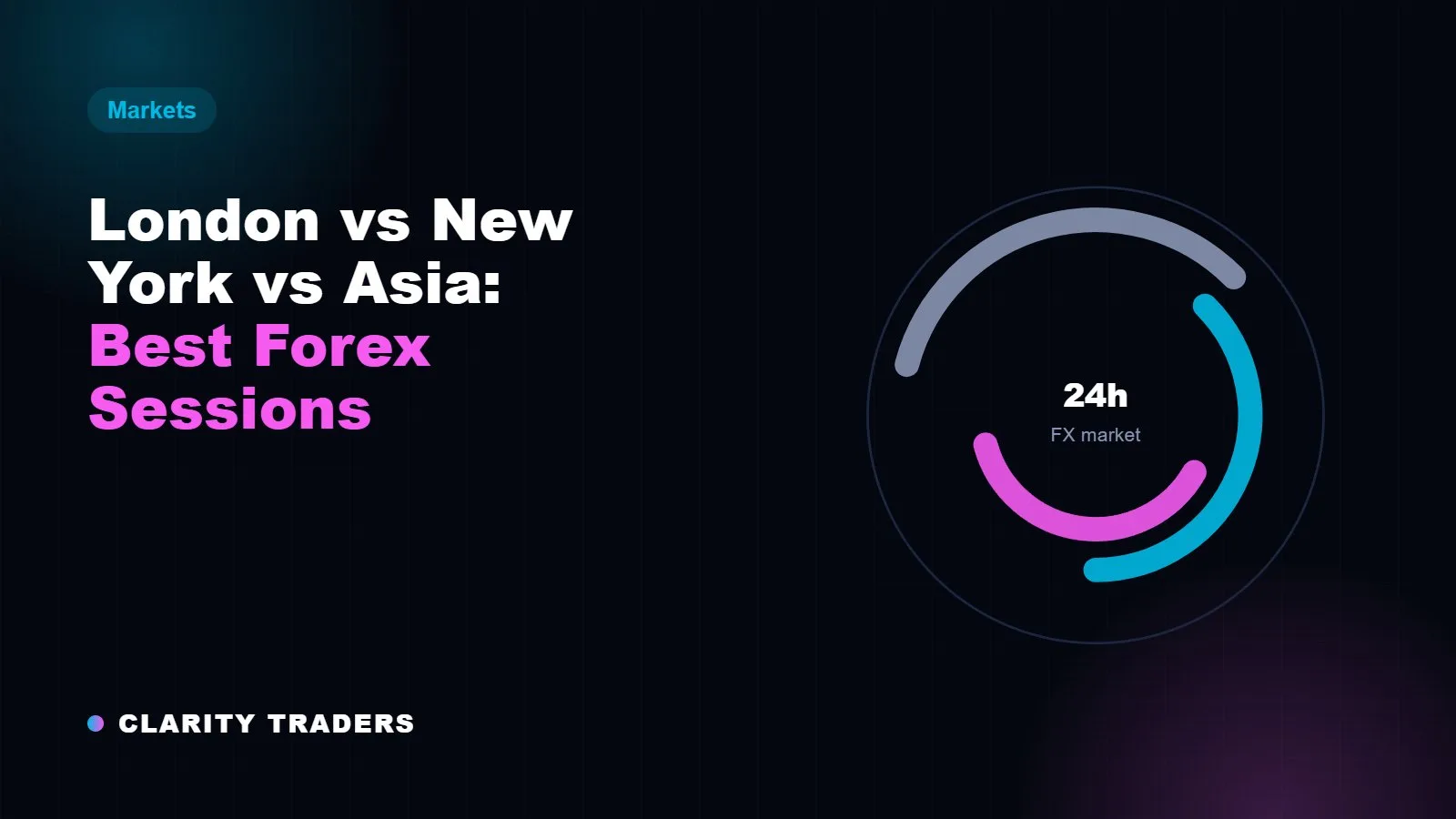
- Asian session (Tokyo, with Sydney before it): about 7:00 pm to 4:00 am ET (00:00 to 09:00 GMT)
- London session: about 3:00 am to 12:00 pm ET (08:00 to 17:00 GMT)
- New York session: about 8:00 am to 5:00 pm ET (13:00 to 22:00 GMT)
The busiest window of the day is the London–New York overlap, roughly 8:00 am to 12:00 pm ET (13:00 to 17:00 GMT).
The Asian session
Character: generally quieter, with smaller ranges in the major European and US pairs.
Pairs that move: JPY, AUD and NZD pairs, such as USD/JPY, AUD/USD and AUD/JPY, especially around Japanese, Australian and Chinese data.
Suits: range traders and traders who want calmer conditions. It is also when many traders mark the range that the London open may later break.
Watch out for: wider spreads during the thin hours around the daily rollover, and sudden moves on regional data or central bank news.
The London session
Character: the most liquid session, with London handling the largest share of global forex volume. Strong directional moves often begin here.
Pairs that move: EUR and GBP pairs (EUR/USD, GBP/USD, EUR/GBP), plus CHF crosses, and USD pairs generally.
Suits: breakout and trend traders. The session breakout strategy is built around the London open.
Watch out for: false breakouts in the first 30 to 60 minutes and sharp moves on UK and eurozone data.
Check live spreads across sessions before you trade.
See Live Spreads →
The New York session
Character: high liquidity, especially during the overlap with London, and heavily driven by US economic data and Federal Reserve news.
Pairs that move: all USD pairs, USD/CAD around Canadian data, and US indices and gold if your account offers them.
Suits: news-aware traders and those who trade momentum in the overlap. After London closes, activity often fades into the afternoon.
Watch out for: major releases such as US jobs and inflation data, which can cause spikes and slippage. Clarity allows news trading, but many traders reduce size around these events.
Which session is best?
For most traders, the London session and the London–New York overlap offer the best combination of liquidity, tighter spreads and clean moves. But "best" depends on you:
- Trend and breakout traders: London open and the overlap.
- Range traders: the Asian session or the late New York afternoon.
- News traders: the New York morning around scheduled US data.
- Part-time traders: whichever window you can trade consistently and alert.
Sessions and prop firm rules
Session choice affects your risk inside prop firm limits:
- Daily loss limits: high-volatility windows can move against you quickly. Size accordingly; see daily vs. maximum drawdown.
- Spreads: trading at the thin rollover hour can add costs and trigger stops.
- Weekend gaps: Clarity allows weekend holding, but Monday's Asian open can gap. Decide on Friday whether a gap could threaten a limit.
How to choose your session
- List the hours you can trade calmly and consistently.
- Match them to the sessions above.
- Back-test your strategy only in those hours.
- Track results by session in your journal and drop the hours that consistently lose.
Trade the session that suits you on a funded account with no minimum trading days.
Explore Funded Trading Accounts →
Typical behaviour of the major pairs by session
Every day is different, but these patterns are a useful starting point.
- EUR/USD: quiet in Asia, active from the London open, busiest in the London–New York overlap.
- GBP/USD: often the most volatile major at the London open. Fast moves suit breakout traders but need careful sizing.
- USD/JPY: active in both the Asian and New York sessions, and sensitive to US yields and Japanese announcements.
- AUD/USD and NZD/USD: respond to Australian, New Zealand and Chinese data in the Asian session, then follow the US dollar later in the day.
- USD/CAD: most active in the New York session, especially around Canadian data and oil price moves.
- Gold (XAU/USD): often moves sharply in the London and New York sessions and around US data.
Daylight saving time: the twice-a-year trap
The US, UK and Europe change their clocks on different dates. For a few weeks each spring and autumn, the gap between the London and New York opens changes by an hour.
- Your favourite session may start an hour earlier or later in your local time.
- The London–New York overlap can be an hour shorter or longer than usual.
- News releases move with their local time, so a US release may land at a different time for you.
Check your platform’s server time and your economic calendar the week clocks change, and adjust your routine.
Session plans for traders in different time zones
Europe and the UK
The London open fits a normal morning, and the overlap fits early afternoon. Many European traders focus on 8:00 to 11:00 and 13:30 to 16:00 local time.
North America
The New York morning and the overlap are the natural choice. Early risers can catch the end of London from about 3:00 am ET, but most trade from 8:00 am to 12:00 pm ET.
Asia and Australia
The Asian session fits the local day, with JPY, AUD and NZD pairs. Evening hours catch the London open, which can be a strong window if you can trade alert at that time.
Part-time traders
Choose one 2 to 3 hour window you can trade every day without rushing. Consistency in one window beats occasional trading in the "best" one.
A session-based trading plan example
Here is a simple plan for a trader in the UK using a London breakout on a $50,000 Two Step account:
- 07:30: mark the Asian session high and low on EUR/USD and GBP/USD; check the calendar.
- 08:00 to 10:00: look for a clean break and retest of the Asian range. Risk 0.5% ($250) per trade, at most two trades.
- 10:00: stop opening new trades. Manage any open position to its stop or target.
- After the session: journal each trade and note the session conditions.
A plan this simple is easy to follow, easy to measure and easy to fit inside the 5% daily and 8% maximum loss limits.
Spreads change across the day, so it helps to watch them through each session before you commit to a trading window. Our live spreads page is a good start, and if you want to see pricing on a personal account, Clarity FX (our broker partner) offers TradeLocker accounts that look and feel like the platform you use here. Keep in mind a live broker account trades your own capital.
Frequently asked questions
What is the most volatile forex session?
The London session and the London–New York overlap usually see the biggest moves in the major pairs.
What is the best session for EUR/USD?
London and the London–New York overlap, when both European and US participants are active.
Is the Asian session good for beginners?
It can be, because it is often calmer, but ranges are smaller. Beginners should focus on one session and learn its behaviour well.
When is the worst time to trade forex?
The rollover hour around 5:00 pm ET, when liquidity is thin and spreads widen, and the quiet Friday afternoon after London closes.
Do sessions matter for gold and indices?
Yes. Gold and major indices are usually most active during the London and New York sessions and around US data releases.
All Clarity Traders accounts are simulated and use virtual funds. Rewards are based on performance in that simulation. This article is for education only and is not financial advice. Trading involves substantial risk.