Why Traders Fail Prop Firm Challenges: 8 Common Mistakes and How to Avoid Them
The eight reasons prop firm challenges are most often lost, from oversized trades to rules nobody read, and a simple checklist to avoid each one.
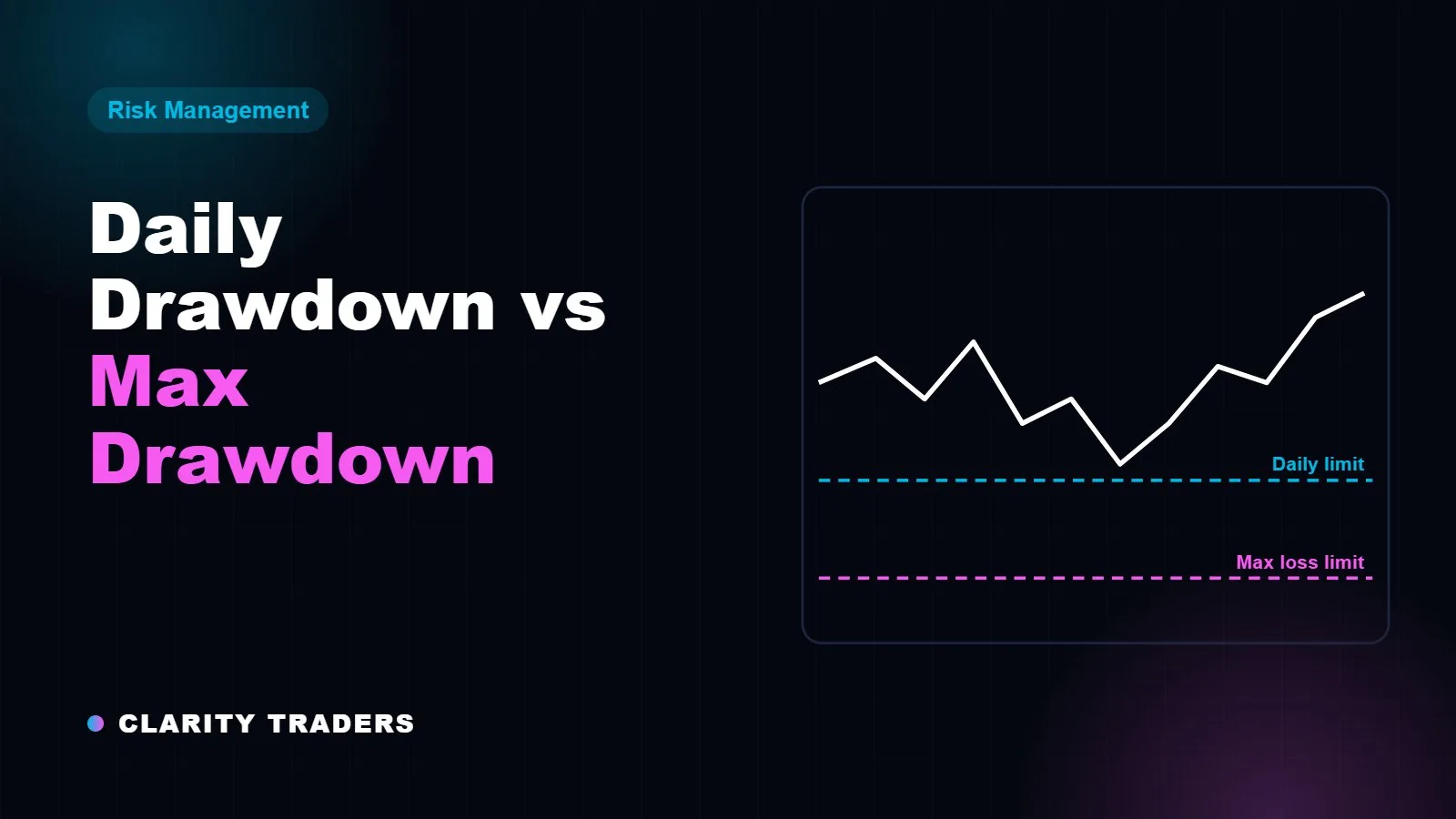
Most prop firm challenges aren't lost because the trader had no edge. They're lost to a handful of avoidable mistakes: a trade that was too big, a bad day that ran past the daily limit, or a rule the trader never read. The good news is that each one has a simple fix. Here are the eight most common, and what to do instead.
Key points
- Most breaches come from position size and the daily loss limit, not from strategy.
- Time pressure causes forced trades. Clarity Traders has no time limit and no minimum days to pass.
- Read the list of banned strategies before your first trade, not after a breach.
- A written daily stop and a lot size calculation remove most of the risk.
1. Risking too much per trade
The fastest way to fail is a position that's too big. If one loss costs 2% on an account with a 4% daily limit, two bad trades end the day, and a few more end the account. Most funded traders risk 0.25% to 1% of the starting balance per trade.
Fix: calculate the lot size from your stop on every trade. Our guide to prop firm lot size shows the formula.
2. Losing track of the daily loss limit
The daily limit is the rule traders break most often, usually on a day that started badly. At Clarity Traders, it's measured from your balance at the start of each trading day. Other firms measure it differently, so check how yours works.
Fix: know the limit in dollars before the session starts, and set a personal stop well above it, for example half the limit. The drawdown calculator shows each limit for your account size.
3. Revenge trading after a loss
A loss feels like something to win back. Traders increase size, take weaker setups or trade outside their usual hours, and one loss turns into a breach.
Fix: set a rule such as stopping for the day after two losses in a row. Walking away costs nothing on an account with no time limit.
4. Rushing to hit the target
Deadlines push traders into forced trades near the end of a challenge. Even without a deadline, many try to pass in a few days with oversized positions.
Fix: treat the target as a by-product of normal trading. Clarity Traders has no time limit and no minimum trading days, so you can pass at your own pace. See prop firms with no minimum trading days.
5. Trading the news without a plan
Spreads widen and price can jump past a stop during major releases. A stop that normally costs $500 can cost more.
Fix: news trading is allowed at Clarity Traders, but cut your size around high-impact releases, or stay flat until the spike settles. Read trading the news at a prop firm.
6. Breaking a rule you didn't read
Some accounts are lost to a banned strategy rather than a loss. At Clarity Traders, these aren't allowed on any account:
- High-frequency trading and latency arbitrage
- Trades held for less than 60 seconds
- Hedging or coordinating trades across accounts, including accounts held by other people
- Market manipulation
Expert Advisors need the EA add-on at checkout, and trading on weekends needs the Trade on Weekends add-on.
Fix: read the trading rules once before your first trade. They take five minutes.
7. Letting the account go inactive
Some traders pause after a few losses and forget about the account. At Clarity Traders, going more than 60 days without placing a trade ends the account.
Fix: put a reminder in your calendar to place at least one trade every 60 days, even a small one.
8. Ignoring the consistency rule at payout
Passing is only half the job. On funded accounts, a consistency rule applies when you request a payout, to make sure rewards come from steady trading rather than one lucky day.
Fix: keep your daily results roughly even. See the consistency rule explained and how to track it.
A quick pre-session checklist
- Today's daily loss limit in dollars, and my personal stop
- Risk per trade in dollars
- High-impact news times for my instruments
- Maximum number of trades or losses before I stop
- No banned strategies, and the add-ons I need are active
Two Step gives you the most room: 5% daily and 8% maximum loss.
See the Two Step account →
Frequently asked questions
Which account is easiest to pass if I keep failing?
At Clarity Traders, Two Step has the widest limits (5% daily, 8% maximum) and a lower first target of 8%. One Step has a single 10% target with tighter limits (4% daily, 6% maximum). Compare the accounts side by side.
Is there a time limit on Clarity Traders challenges?
No. There's no time limit and no minimum number of trading days to pass. You do need to place at least one trade every 60 days to keep the account active.
Can I hold trades overnight and over the weekend?
Yes. Holding trades overnight and over the weekend is allowed on every account. Opening trades on weekends needs the Trade on Weekends add-on.
All Clarity Traders accounts are simulated and use virtual capital. Trading involves significant risk. This page summarises the rules; the Terms & Conditions take priority if anything differs.
All Clarity Traders accounts are simulated and use virtual funds. Rewards are based on performance in that simulation. This article is for education only and is not financial advice. Trading involves substantial risk.