Instant Funding vs. 1-Step vs. 2-Step Challenges: Which Is Best?
Instant funding skips the evaluation, a 1-step challenge has one target and a 2-step gives you the most room. Here is how they really compare and who each one suits.
Key takeaways
- Instant skips the evaluation but has the tightest limits: 3% daily and 5% maximum loss.
- One Step needs a single 10% target with a 4% daily and 6% maximum loss limit.
- Two Step splits the target into 8% and 5% and gives the most room: 5% daily and 8% maximum.
- Pick the account whose loss limits fit your real drawdown, not the one that looks cheapest or fastest.
Every prop firm account answers the same question in a different way: how do you prove you can manage risk before you trade a funded account? Instant funding skips the test, a 1-step challenge asks you to hit one profit target, and a 2-step challenge splits the test into two smaller targets. None of them is "best" for everyone. The right choice depends on your strategy, your drawdown tolerance and how quickly you want to reach payouts.
This guide explains how each model works, compares the numbers side by side using Clarity Traders' current rules, and gives you a simple way to decide.
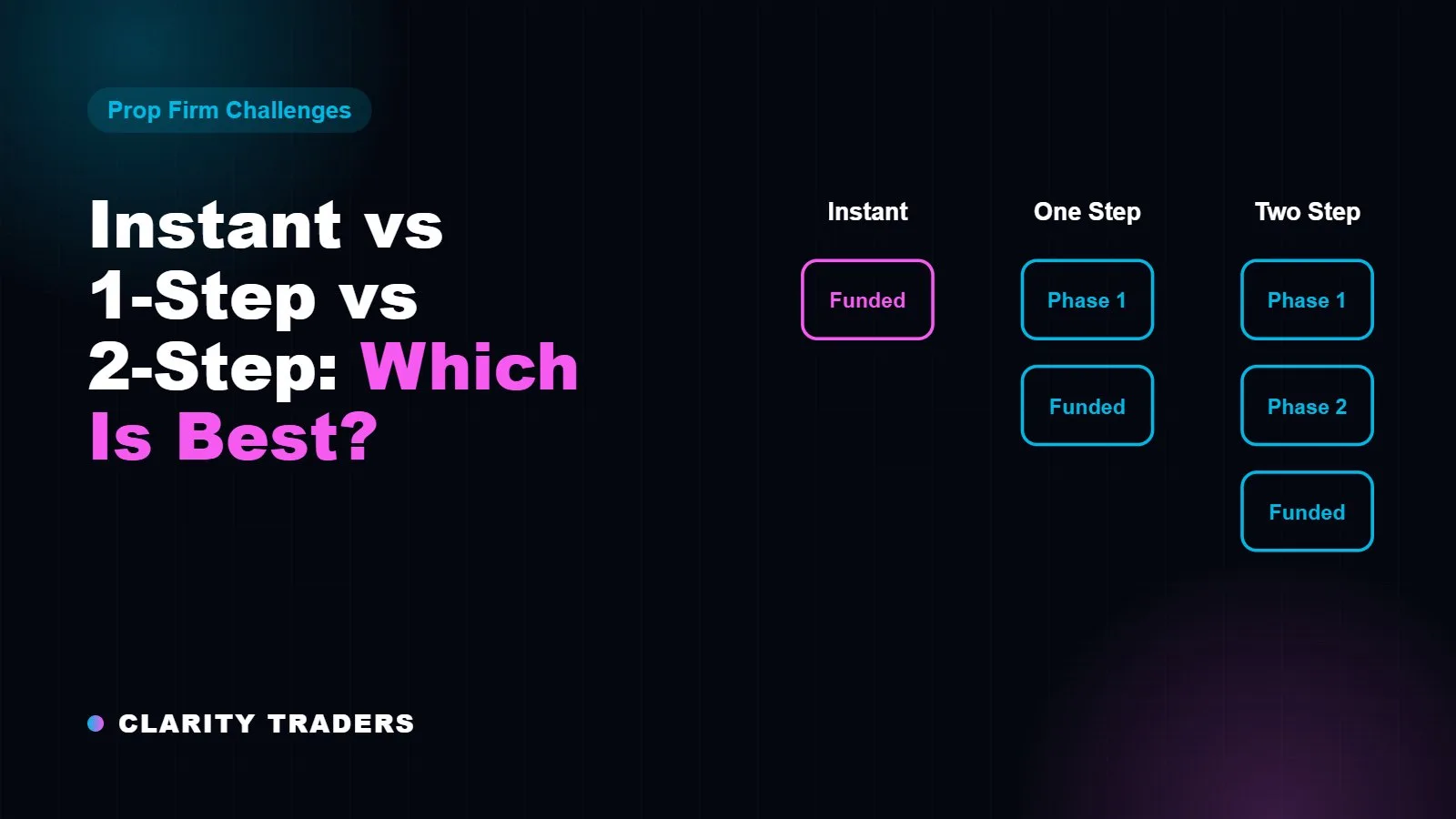
The three account types in one minute
- Instant funding: you start on a funded (simulated) account straight away. There is no profit target, but the loss limits are tighter and the entry fee is higher.
- 1-step challenge: one evaluation phase with a single profit target. Pass it and you are funded.
- 2-step challenge: two evaluation phases with smaller targets and usually more drawdown room. It takes longer, but each step is easier.
Side-by-side comparison
Here is how the three options compare at Clarity Traders. All accounts are simulated, available from $5,000 to $200,000, and have no minimum trading days and no time limit.
- Evaluation: Instant none · One Step 1 phase · Two Step 2 phases
- Profit target: Instant none · One Step 10% · Two Step 8%, then 5%
- Daily loss limit: Instant 3% · One Step 4% · Two Step 5%
- Max loss limit during evaluation: Instant n/a · One Step 6% · Two Step 8%
- Max loss limit once funded: Instant 5% · One Step 10% · Two Step 10%
- Consistency rule (funded): Instant 10% · One Step 20% · Two Step 20%
- Starting price ($5K account): Instant $95 · One Step $59 · Two Step $55
You can see the full rules for every size on the Compare Accounts page.
Instant funding: pay more, skip the test
Instant funding is built for traders who already have a proven, repeatable approach and want to reach payouts without an evaluation. You trade a funded account from day one, so every profitable day counts toward your first reward request.
The trade-off is risk room. With a 3% daily and 5% maximum loss limit, there is less space for a strategy with deep swings. A consistency rule also applies when you request a payout, so one huge day cannot carry the whole request.
Instant funding suits you if
- You trade with small, controlled risk per trade (for example 0.25% to 0.5%).
- Your results are spread across many days rather than a few big wins.
- You value speed to payout over the lowest entry price.
Skip the evaluation with an Instant account: no profit target, up to 100% reward split.
See Instant accounts →
1-step challenge: one target, then funded
A 1-step challenge is the simplest evaluation. At Clarity Traders you need to reach a 10% profit target while staying inside a 4% daily and 6% maximum loss limit. Once you pass, the account moves to funded rules: no profit target, the max loss limit widens to 10%, and you can request rewards.
The challenge is the ratio between target and drawdown. You need to make 10% without ever losing 6% from the start. That rewards traders with a positive edge and a tight stop discipline, and it punishes revenge trading.
1-step suits you if
- You want the fastest route to funding through an evaluation.
- Your strategy has a good win rate or reward-to-risk ratio and modest drawdowns.
- You prefer one clear goal instead of two phases.
2-step challenge: smaller targets, more room
A 2-step challenge splits the evaluation in two. At Clarity Traders, Phase 1 asks for 8% and Phase 2 for 5%, with a 5% daily and 8% maximum loss limit in both phases. That is the most drawdown room of any Clarity evaluation, and it is the lowest-priced option.
Because each target is smaller and the loss limits are wider, a single bad week is less likely to end your attempt. The cost is time: you have to pass twice.
2-step suits you if
- You are newer to prop trading or still refining your process.
- Your strategy sometimes goes through deeper drawdowns before recovering.
- You want the lowest entry price and the most margin for error.
Which is easiest to pass?
A useful way to judge difficulty is the target-to-drawdown ratio: how much you must make compared with how much you are allowed to lose.
- One Step: 10% target ÷ 6% max loss ≈ 1.7
- Two Step, Phase 1: 8% ÷ 8% = 1.0
- Two Step, Phase 2: 5% ÷ 8% ≈ 0.6
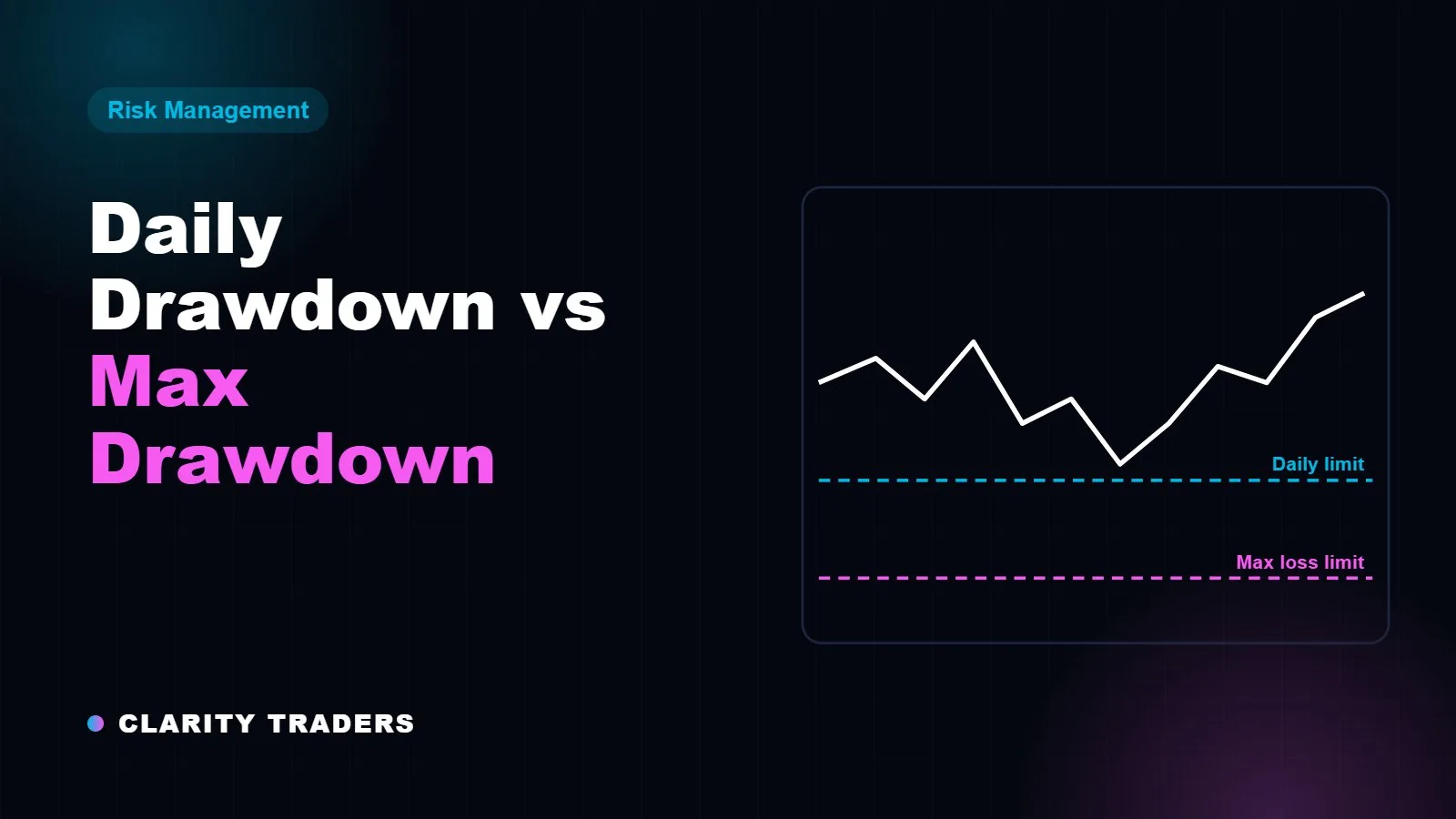
The lower the ratio, the more forgiving the phase. By this measure each Two Step phase is easier than the One Step, even though you must complete two of them. For a deeper look at how the loss limits work, read Daily Drawdown vs. Maximum Drawdown.
What about cost?
Entry fee is only part of the picture. If a cheaper evaluation takes two attempts, it can cost more than a pricier one you pass first time. Ask yourself honestly how often your strategy would breach each set of limits, then compare the expected cost, not just the sticker price. Clarity's optional Refund Guarantee add-on refunds your fee after your first successful payout, which can tilt the maths further.
How to decide in three questions
- Do you already have a track record of controlled risk? If yes, consider Instant. If not, choose an evaluation.
- How deep are your normal drawdowns? If you regularly dip 5% or more before recovering, the Two Step gives you the room you need.
- Do you want the quickest evaluation? If your drawdowns are shallow and you want one clear goal, the One Step is the fastest path.
Not sure yet? Every Clarity account has no minimum trading days and no time limit.
Explore Funded Trading Accounts →
A worked example on a $50,000 account
Percentages are easy to compare but hard to feel. Here is what each option looks like in dollars on a $50,000 account at Clarity Traders.
Instant ($50,000)
- Profit target: none. You can request rewards from your first payout cycle once you meet the eligibility rules.
- Daily loss limit: 3%, or $1,500 in a single day.
- Maximum loss limit: 5%, so you can never be more than $2,500 below the starting balance.
One Step ($50,000)
- Profit target: 10%, or $5,000.
- Daily loss limit: 4%, or $2,000.
- Maximum loss limit during the evaluation: 6%, so your floor is $47,000.
- Once funded, the maximum loss limit widens to 10% ($5,000).
Two Step ($50,000)
- Profit targets: 8% ($4,000) in Phase 1, then 5% ($2,500) in Phase 2.
- Daily loss limit: 5%, or $2,500.
- Maximum loss limit in both phases: 8%, so your floor is $46,000.
- Once funded, the maximum loss limit is 10% ($5,000).
Notice the difference in breathing room. On the Instant account a $2,500 losing run ends the account. On the Two Step you can lose $4,000 and still pass. That gap matters far more than the $40 or so difference in entry fee.
How long until your first payout?
Time to first payout is often the deciding factor, so it is worth estimating honestly. Suppose your strategy averages around 3% a month with controlled risk. These are illustrations, not promises, but they show how the models differ:
- Instant: no evaluation, so your first reward request can come at the end of your first payout cycle, provided you are in profit and meet the consistency rule.
- One Step: at 3% a month, the 10% target takes roughly three to four months. Then you are funded and on the payout schedule.
- Two Step: about three months for the 8% Phase 1 and around two months for the 5% Phase 2, so roughly five months before you are funded.
If your monthly average is higher, every timeline shrinks. If you force trades to hit targets faster, the chance of a breach rises sharply. Because Clarity evaluations have no time limit, there is no reason to rush.
Add-ons that change the comparison
Optional add-ons can shift which account makes the most sense for you:
- Refund Guarantee: refunds your fee after your first successful payout, which makes a challenge cheaper over time if you pass.
- 100% Rewards: you keep all eligible simulated profits instead of the standard split.
- Express Payouts: shortens the payout cycle from every 14 days to weekly.
- EA's Allowed: lets you run Expert Advisors that follow the trading policies.
- Double Leverage: more buying power on the same balance. Use it carefully; larger positions breach limits faster.
Add-ons are listed at checkout. Pick them for a specific reason, not by default.
Common mistakes when choosing an account
- Choosing on price alone. The cheapest option is only cheapest if you pass it.
- Picking Instant to skip a test you would fail. If your strategy cannot stay within a 5% maximum loss, an Instant account will not change that.
- Ignoring your real drawdown. Look back at your last few months of trading. If you regularly drop 6% before recovering, the One Step limits will feel tight.
- Buying the biggest account size first. Bigger accounts magnify mistakes in dollars. Many traders start smaller, learn the rules, then scale.
- Not reading the funded rules. Passing is half the journey. Check the consistency rule and payout schedule before you buy.
Frequently asked questions
Is instant funding better than a challenge?
Not automatically. Instant funding removes the evaluation but gives you tighter loss limits and a consistency rule. Traders with steady, low-risk strategies tend to benefit most; traders who need room to recover from drawdowns usually do better with a challenge.
Which challenge has the highest pass rate?
Firms rarely publish reliable pass rates, so focus on the rules. With smaller targets and wider loss limits, two-step evaluations are generally more forgiving per phase than one-step evaluations.
Do I keep the same rules once I am funded?
No. At Clarity Traders the profit target disappears once you are funded, the max loss limit on One Step and Two Step widens to 10%, and a consistency rule applies to payout requests. See How Prop Firm Payouts Work for the details.
Can I lose more than the account fee?
No. Clarity Traders accounts are simulated, so you trade virtual funds. The most you can lose is the fee you paid for the account and any add-ons.
Which account sizes are available?
Instant, One Step and Two Step accounts are available from $5,000 to $200,000. Larger sizes cost more but scale the profit target, the loss limits and the potential rewards in proportion.
Can I trade the news or hold over the weekend?
Yes. Clarity allows trading high-impact news and holding positions over the weekend on all three account types. Gaps can move price past your stop, so size positions with that in mind.
All Clarity Traders accounts are simulated and use virtual funds. Rewards are based on performance in that simulation. This article is for education only and is not financial advice. Trading involves substantial risk.