Forex Prop Firms vs. Futures Prop Firms: Which Should You Choose?
Forex and futures prop firms differ in markets, trading hours, drawdown style and costs. This comparison explains the trade-offs so you can pick the right fit for your strategy.

Key takeaways
- Forex prop firms trade currencies around the clock on MT5-style platforms, sized in lots.
- Futures prop firms trade exchange contracts with set hours and often use trailing drawdown.
- Forex suits traders who want flexible hours and fine-grained position sizing.
- Choose the market you already understand and the drawdown model your strategy can live with.
Prop firms fall into two broad camps: forex (and CFD) prop firms, which offer currency pairs, indices, metals and more, and futures prop firms, which offer exchange-traded contracts. Both can lead to funded accounts and payouts, but the day-to-day experience is very different. This guide compares them so you can choose based on how you actually trade.
Clarity Traders is a forex and CFD prop firm. We have kept this comparison general so it is useful whichever route you take; always check the exact rules of any firm before you buy.
The markets you trade
Forex and CFD prop firms
You trade currency pairs such as EUR/USD and GBP/JPY, and often indices, gold and other instruments as CFDs. Prices come from liquidity providers in a decentralised, over-the-counter market. Costs are mainly spreads and, on some instruments, commissions.
Futures prop firms
You trade standardised contracts listed on exchanges, such as equity index, crude oil or gold futures. Prices come from a central exchange order book, so volume and order-flow data are available. Costs are mainly commissions and exchange fees, and platforms often charge for market data.
Trading hours
The forex market runs 24 hours a day, five days a week, moving through the Asian, London and New York sessions (see the best forex trading sessions). Futures also trade nearly around the clock on weekdays, but with a daily maintenance break, and many futures prop firms require positions to be closed before the session ends and over the weekend.
At Clarity Traders you can hold trades over the weekend and trade during high-impact news.
How drawdown is measured
This is often the biggest practical difference.
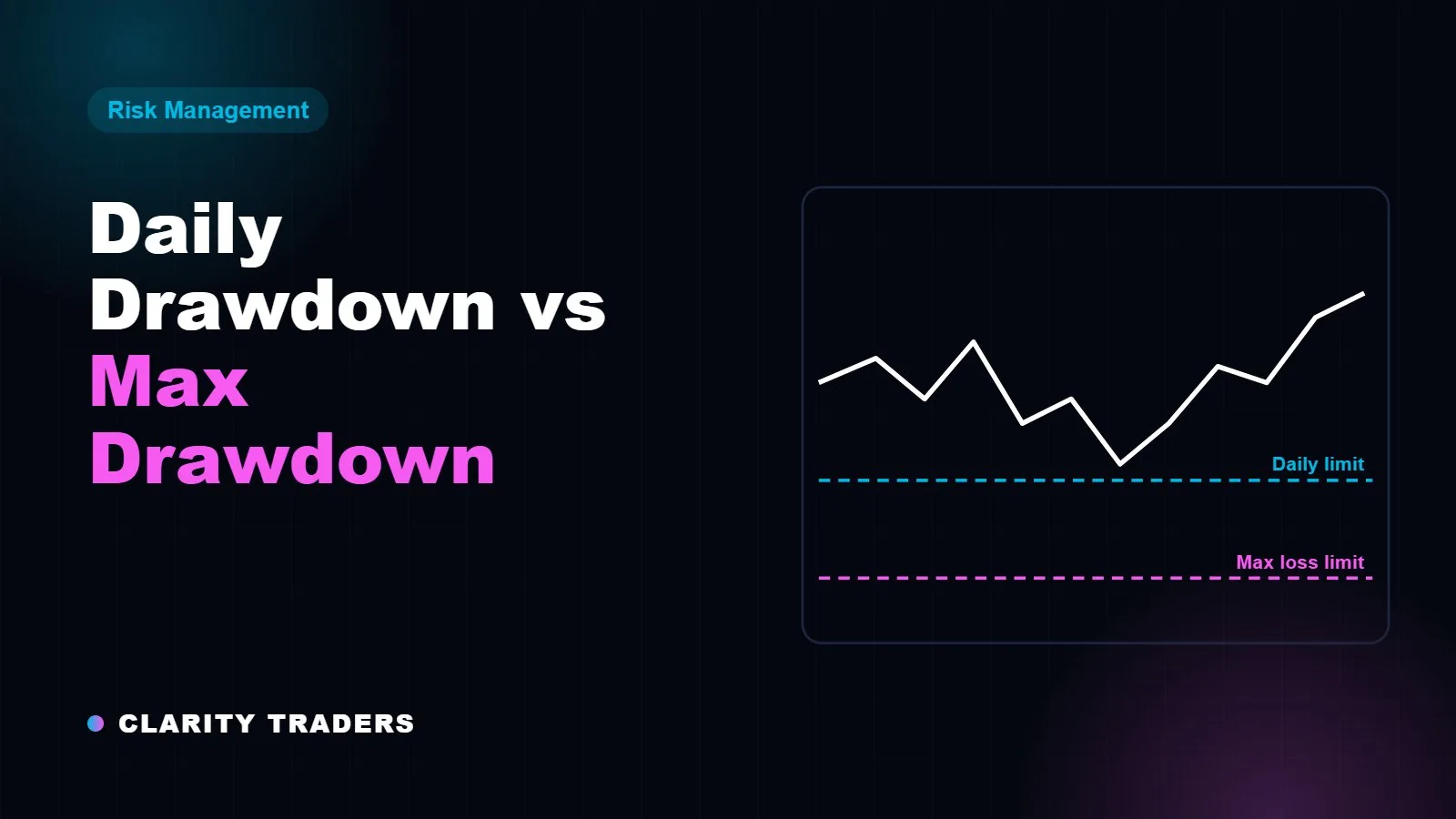
- Many forex prop firms use a daily loss limit plus a maximum loss limit measured from the starting balance. At Clarity, for example, the Two Step uses a 5% daily and 8% maximum loss limit during the evaluation.
- Many futures prop firms use a trailing drawdown that follows your highest balance, either at the end of the day or intraday, until it locks at a set level.
A trailing drawdown means unrealised profits that you give back can still count against you, which suits some styles and frustrates others. Read Daily Drawdown vs. Maximum Drawdown for a full explanation.
Forex, indices and metals on TradeLocker or MT5, with clear published loss limits.
Compare Clarity accounts →
Position sizing
In forex you size in lots, which can be adjusted in small increments, making it easy to risk an exact percentage. In futures, each contract has a fixed value per point, and firms usually cap the number of contracts you can hold. Micro contracts help, but sizing is less granular.
Platforms
Forex prop firms commonly use platforms such as MetaTrader 5 and TradeLocker; Clarity supports both. Futures firms typically use dedicated futures platforms connected to exchange data feeds.
Pricing models
Forex prop firms usually charge a one-time evaluation fee per attempt. Many futures prop firms use monthly subscription pricing for evaluations, plus possible activation or data fees. Compare total cost to funded, not just the headline price.
Which should you choose?
A forex prop firm may suit you if
- You want to trade currencies, gold and indices from one account.
- You value precise position sizing and a fixed, balance-based maximum loss limit.
- You want the option to hold trades overnight and over the weekend.
- You prefer a one-time fee per evaluation.
A futures prop firm may suit you if
- You specialise in exchange-traded index or commodity futures.
- You rely on volume and order-flow tools.
- You are comfortable with trailing drawdowns and closing positions daily.
The bottom line
Neither type is better for everyone. Start from your strategy: the markets you know, the hours you can trade and the drawdown style you can live with. Then choose the firm whose rules fit. If forex and CFDs are your focus, compare Clarity's Instant, One Step and Two Step accounts.
Trade forex, indices and gold with no minimum trading days.
Explore Funded Trading Accounts →
Costs compared: spreads, commissions and fees
Trading costs work differently in each market, and they add up over hundreds of trades.
- Forex: you pay the spread (the gap between buy and sell prices) and, on many accounts, a commission per lot. Spreads are tightest on major pairs during active sessions and widen around the daily rollover and big news.
- Futures: you pay exchange and clearing fees plus a commission per contract. The bid-ask spread on liquid contracts is usually one tick, but each tick has a fixed dollar value that can be large.
You can check live forex conditions on Clarity’s live spreads page.
Same idea, two markets: a worked comparison
Say you want to risk $500 on a trade with a stop equal to a normal intraday move.
Forex example
On EUR/USD with a 25-pip stop and a pip value of about $10 per standard lot, $500 of risk is 2.0 lots. If you want $400 instead, you trade 1.6 lots. Position size can be adjusted in small steps.
Futures example
On a contract where a typical stop is worth $250 per contract, $500 of risk is two contracts. If you want $400 of risk, you cannot trade 1.6 contracts, so you choose between one contract ($250) and two ($500), or move to a smaller micro contract if one exists.
This granularity is one of the most practical differences. Forex lets you size precisely to your risk plan on any account size.
Questions to ask any prop firm before you buy
Whichever market you choose, these questions reveal most of what matters:
- How is drawdown measured? Static or trailing, on balance or on equity, and when does the daily limit reset?
- What is the total cost to get funded? Include resets, subscriptions, activation and data fees.
- What are the payout rules? Schedule, split, minimums, consistency rules and payment methods.
- What is not allowed? News trading, weekend holding, EAs, copy trading and hedging rules vary a lot.
- How do I reach support? Live chat and email response times matter when something goes wrong.
At Clarity, most of these answers are on the Compare Accounts page and in the FAQ.
Switching from futures to forex
If you are moving from futures to a forex prop firm, a few habits need adjusting:
- Learn pip values. They differ by pair. Use a calculator until sizing becomes second nature.
- Watch the session clock. Forex volatility follows the London, New York and Asian sessions rather than one exchange open.
- Re-read the drawdown rules. Forex firms often measure limits differently from futures firms. At Clarity, check how the daily and maximum limits work on your account type.
- Expect weekend gaps. Clarity allows weekend holding, but Monday opens can gap past stops.
Frequently asked questions
Is forex or futures prop trading easier?
Neither is easier in general. Forex accounts often offer more flexible position sizing and balance-based limits, while futures offer centralised exchange data. The better fit depends on your strategy.
Can I trade gold and indices with a forex prop firm?
Often yes, as CFDs. Check each firm's instrument list. At Clarity you can see live conditions on the Live Spreads page.
Do futures prop firms allow weekend holding?
Many do not. Rules vary, so always read the firm's terms.
Which has lower costs, forex or futures?
It depends on the instrument, your trade frequency and the firm’s pricing model. Compare spread plus commission per trade, and include any monthly fees.
All Clarity Traders accounts are simulated and use virtual funds. Rewards are based on performance in that simulation. This article is for education only and is not financial advice. Trading involves substantial risk.