The Best Forex Pairs for Funded Traders (and Which to Avoid)
Which currency pairs suit prop firm accounts best: costs, volatility, session timing and correlation, plus how to build a small watchlist that fits your strategy and loss limits.
Key takeaways
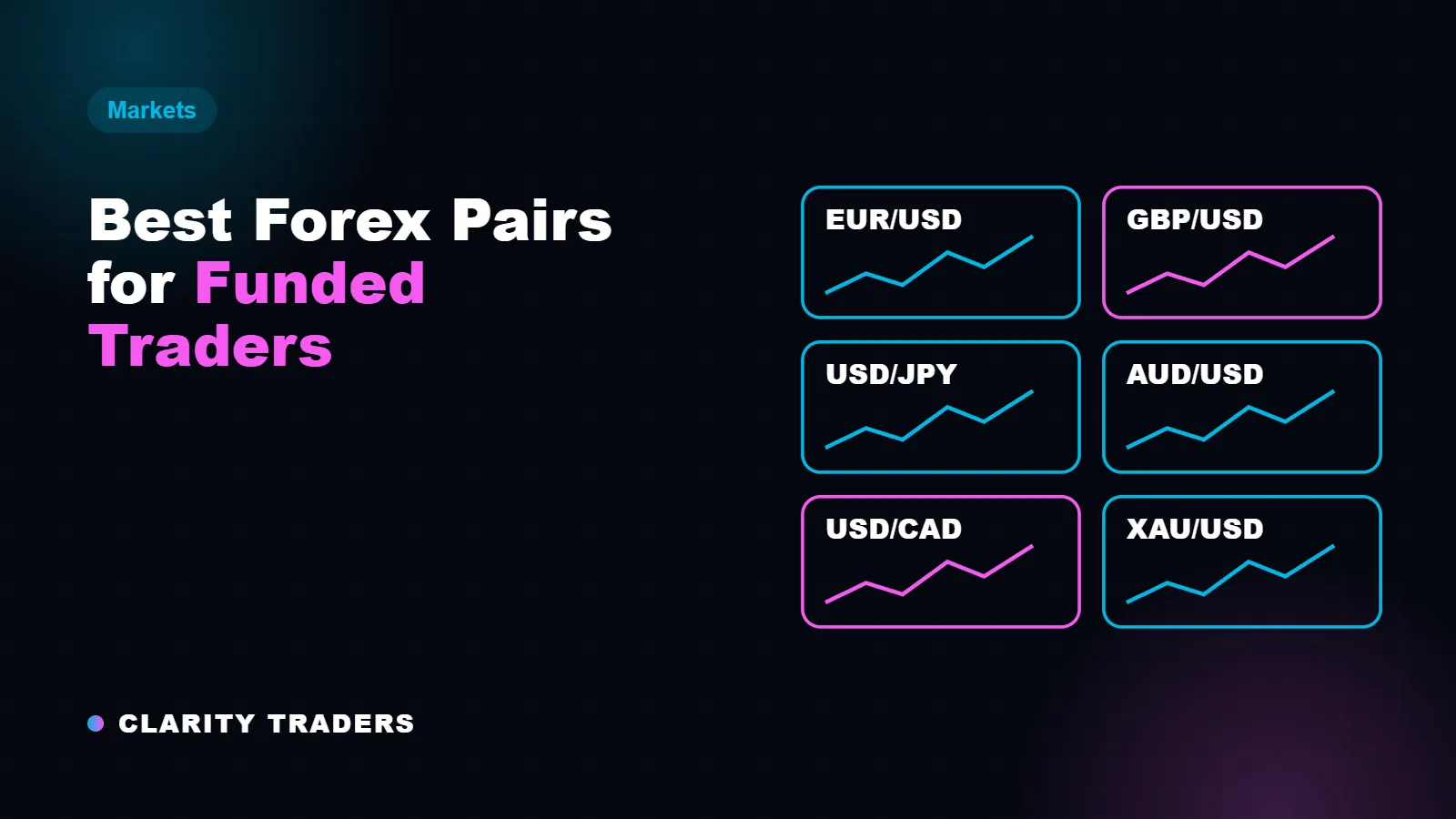
- Major pairs such as EUR/USD, GBP/USD and USD/JPY usually offer the lowest costs and deepest liquidity.
- Match each pair to the session when it is most active, and avoid thin hours.
- Correlated pairs act like one larger position, so count their risk together.
- A focused watchlist of three to five instruments beats scanning dozens of charts.
There is no single “best” currency pair, but some pairs are much easier to trade inside prop firm rules than others. Costs, volatility and timing all affect how quickly a trade can reach your daily or maximum loss limit. This guide compares the main groups of pairs and shows how to build a small watchlist that suits your strategy.
What makes a pair prop-firm friendly?
- Low trading costs: tight spreads mean less of your risk is spent on getting in and out.
- Deep liquidity: smoother price action and less slippage.
- Predictable activity: clear hours when the pair moves and when it is quiet.
- Manageable volatility: moves big enough to trade, but not so wild that stops are constantly hit.
The majors
EUR/USD
The most traded pair in the world. Usually the tightest spreads and steady liquidity, most active in the London session and the London–New York overlap. A strong default for most strategies.
GBP/USD
More volatile than EUR/USD, with bigger moves at the London open. Good for breakout traders, but size carefully: the same stop distance can be hit faster.
USD/JPY
Active in both the Asian and New York sessions and sensitive to US yields. Useful for traders in Asian time zones or those who trade the US morning.
AUD/USD and NZD/USD
Respond to Australian, New Zealand and Chinese data in the Asian session. Often calmer, which suits range traders.
USD/CAD and USD/CHF
USD/CAD is most active in the New York session and around oil and Canadian data. USD/CHF often moves opposite to EUR/USD, which matters for correlation.
Crosses and exotics
Crosses such as EUR/GBP, EUR/JPY and GBP/JPY do not include the US dollar. Some, like EUR/JPY, are popular and liquid. Others, especially exotic pairs involving emerging-market currencies, usually have wider spreads and sudden moves. On a prop account with tight loss limits, most traders keep exotics to a minimum.
Check live spreads on the pairs you trade before every session.
See Live Spreads →
Gold and indices
Many funded traders also trade gold (XAU/USD) and major indices. They can move a lot in a short time, so position sizes are usually much smaller than on major currency pairs for the same dollar risk. If you add them, use a position size calculator every time and check the contract details on your platform.
Correlation: the hidden risk
Long EUR/USD, long GBP/USD and short USD/CHF are three trades, but often one idea: a weaker US dollar. If each risks 0.5%, your real exposure can be close to 1.5%. On an account with a 4% daily limit, that matters. Count correlated trades together and cap your total open risk. Our risk management rules explain how.
Match pairs to your session
- Asian session: USD/JPY, AUD/USD, NZD/USD, AUD/JPY.
- London session: EUR/USD, GBP/USD, EUR/GBP, EUR/JPY.
- New York session: EUR/USD, USD/CAD, USD/JPY, gold.
See the best forex trading sessions for times and conditions in each window.
[position-size-calculator]
Build a focused watchlist
- Pick your session based on when you can trade calmly.
- Choose three to five instruments that are active in that session.
- Check that they are not all the same trade in disguise, for example several USD pairs moving together.
- Back-test your strategy on each one and drop any that do not suit it.
- Review every month using your journal: which pairs make money and which cost you?
Trade forex, gold and indices on a funded account with no minimum trading days.
Explore Funded Trading Accounts →
Once you know which pairs suit your style, some traders also keep a small personal account to trade them outside an evaluation. If that is you, Clarity FX, the broker partner in the Clarity network, runs on TradeLocker, the same platform as Clarity Traders accounts, so your charts and workflow carry over. A personal account uses your own money, so size it with the same care you use on a funded one.
Frequently asked questions
What is the best pair for beginners?
EUR/USD is the most common starting point because of its liquidity and low costs. Learn one pair well before adding more.
Should I trade exotic pairs on a prop account?
Usually sparingly. Wider spreads and sudden moves make loss limits harder to manage.
How many pairs should I trade?
Most funded traders do well with three to five instruments. Fewer charts mean better decisions.
Is gold a good instrument for funded traders?
It can be, but it moves quickly. Use smaller position sizes and check your risk carefully on every trade.
All Clarity Traders accounts are simulated and use virtual funds. Rewards are based on performance in that simulation. This article is for education only and is not financial advice. Trading involves substantial risk.